⚡ Quick Answer
For agency owners, outsourcing GoHighLevel work means handing off sub-account setup, automations, funnels, snapshots, and ongoing platform maintenance to a dedicated team of GHL specialists, so you stop being the bottleneck and start scaling. The realistic timeline from hiring to full handoff is 2 to 4 weeks with a proper fulfillment partner, and 6 to 12 weeks if you go the freelancer or VA route. GHL Desk onboards qualifying agencies in 48 hours with pre-vetted GoHighLevel experts who work under your brand, white-label. If you are drowning in client builds, chasing freelancers, or losing sleep over broken automations, this guide breaks down exactly how outsourcing GoHighLevel work should be approached in 2026: what to delegate, what to keep in-house, and how to pick the right partner without getting burned.
If you are running a GoHighLevel-based agency in 2026, there is a good chance you are the single biggest bottleneck in your own business. You close a client on a Monday, and by Friday you are building their funnel, fixing a broken automation, and responding to a subaccount error at 11pm. Growth stops because fulfillment swallows every hour you have.
Most articles about outsourcing GoHighLevel are written by virtual assistant companies pitching their VA service. This one is written from the other side by people who run GHL fulfillment for agencies every day. What follows is the honest breakdown of how to outsource GoHighLevel work correctly, where agencies go wrong, and what the process actually looks like in 2026.
Why Agencies Outsource GoHighLevel Work in 2026
The first thing to understand is that GoHighLevel is not a platform most agency owners should be operating themselves by the time they cross three or four clients. The platform is powerful, but its power comes from depth and depth demands a full-time operator who lives inside the system every day.
As of 2026, the average GHL agency manages between 8 and 25 sub-accounts, and each sub-account requires ongoing pipeline maintenance, workflow monitoring, snapshot updates, integration fixes, and client-facing reporting. That is not a part-time workload. For an agency owner running sales, strategy, and client relationships at the same time, doing GHL work personally is not frugal it is expensive. Every hour spent inside a workflow builder is an hour not spent closing a new client or keeping an existing one happy.
There is also the quality problem. GHL updates constantly in 2026 new AI features, conversation-level updates, workflow action changes, reporting overhauls. Someone managing GHL casually will miss these updates. Someone managing GHL full-time will not. The difference shows up in client retention rates within three to six months.
The third driver is silent and often underestimated: fulfillment bottlenecks destroy sales capacity. Agencies that cannot deliver fast enough stop selling, because every new client creates more work the owner already does not have time for. This is how agencies plateau at $15k–$30k per month and stay there for years. Outsourcing GHL work is the single highest-leverage fix for this specific plateau.
The Three Outsourcing Models Which One Fits Your Agency
There is no single correct way to outsource GoHighLevel work. The right model depends on your stage, client volume, margin structure, and how white-label your operation needs to be. The mistake most agency owners make is choosing the cheapest option available and then blaming outsourcing when it fails. Match the model to your reality.
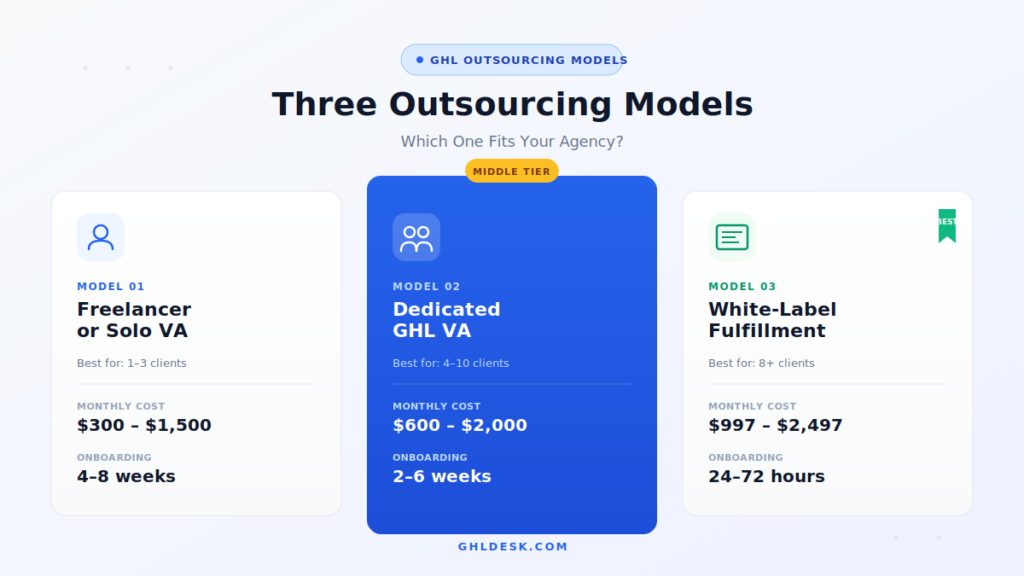
Model 1 applies if you are a solo operator or early-stage agency with 1 to 3 clients, limited budget, and mostly one-off GHL tasks rather than ongoing builds.
Model 2 applies if you are running 4 to 10 clients, you want a dedicated person inside your GHL account, and you are comfortable managing one VA directly.
Model 3 applies if you are running 8+ clients, want a white-label team, need multiple skill sets (not just GHL), and want to stop managing freelancers entirely.
Each model has a different cost structure, a different timeline, and a very different level of risk. Picking the wrong model particularly going too cheap too early or too expensive too late is how agencies waste months and lose clients.
Model 1 Freelancer or Solo VA
This is the most common starting point and the model with the widest quality range in the entire GHL ecosystem.
What it looks like. You find a GHL freelancer on Upwork, Fiverr, or a Facebook group. You pay hourly (typically $8 to $25 per hour) or project-based. They handle one-off builds a funnel, a snapshot, an automation. Communication is direct, usually over Slack, Telegram, or WhatsApp.
Where it works. Simple, isolated tasks. Building a single funnel. Setting up one snapshot. Migrating data. If the scope is tight and the work is finite, a skilled freelancer delivers fine.
Where it breaks. The moment you need ongoing management. Freelancers disappear when your workload peaks, go silent for days when problems hit, and rarely document their work. If the freelancer moves on, you inherit a mess that no one else can decode. For agencies past two or three clients, this model becomes the source of the chaos you were trying to escape.
Realistic cost. $300 to $1,500 per month depending on volume.
Realistic timeline. A single project typically takes 1 to 3 weeks. Onboarding a freelancer into your workflow reliably takes 4 to 8 weeks of back-and-forth.
Model 2 GoHighLevel VA Agency
This is the middle tier and where most agency owners land when they graduate from freelancers but are not yet ready for a full fulfillment partner.
What it looks like. You hire a dedicated VA from a VA sourcing company typically Filipino or South Asian, English-proficient, trained specifically on GoHighLevel. They work 20 to 40 hours per week, exclusively on your accounts. You pay a flat monthly retainer, usually through the sourcing company. The VA slowly learns your agency’s specific workflows over 4 to 12 weeks.
Where it works. For agencies with steady client volume (4 to 10 clients), consistent task flow, and the willingness to manage a person. A good GHL VA becomes a real operational asset within 60 to 90 days.
Where it breaks. You still manage the VA. If they are sick, overloaded, or underperforming, that is your problem. One VA cannot cover the full range of skills an agency needs they handle GHL well but do not touch design, ads, video, or appointment setting. You end up stacking multiple VAs from multiple sources, and coordinating them becomes its own full-time job.
Realistic cost. $600 to $2,000 per month for one dedicated VA.
Realistic timeline. Onboarding 2 to 6 weeks. Full independence typically by week 8 to 12.
Model 3 White-Label Fulfillment Partner
This is the model agencies move to when they stop wanting to manage anyone and start wanting to focus purely on sales and strategy.
What it looks like. You contract with a white-label fulfillment company that operates as a silent extension of your agency. Instead of one VA, you get a team GHL specialists, automation builders, funnel designers, and often a project manager coordinating delivery. They work under your brand, your clients never know they exist, and the fulfillment company handles quality control internally.
Where it works. For agencies with 8+ clients, growing fast, selling multiple service types, or operating in SaaS mode. The white-label model is the only one that scales without the owner becoming a full-time HR manager.
Where it breaks. Cheap white-label providers cut corners on quality. The wrong partner will give you low-cost output that damages your client relationships. This model requires choosing a partner with real GHL depth, not a generic marketing agency that added “GHL services” to its menu.
Realistic cost. $997 to $2,497 per month for most agencies. Enterprise tiers scale beyond that.
Realistic timeline. Onboarding is usually 24 to 72 hours with a specialist partner. Full operational handoff typically complete within 2 to 4 weeks.
What GoHighLevel Work You Should Actually Outsource
Not every task is equally worth outsourcing, and not every task should be handed off immediately. Sequence matters. Here is the order that produces the biggest ROI for most agencies.
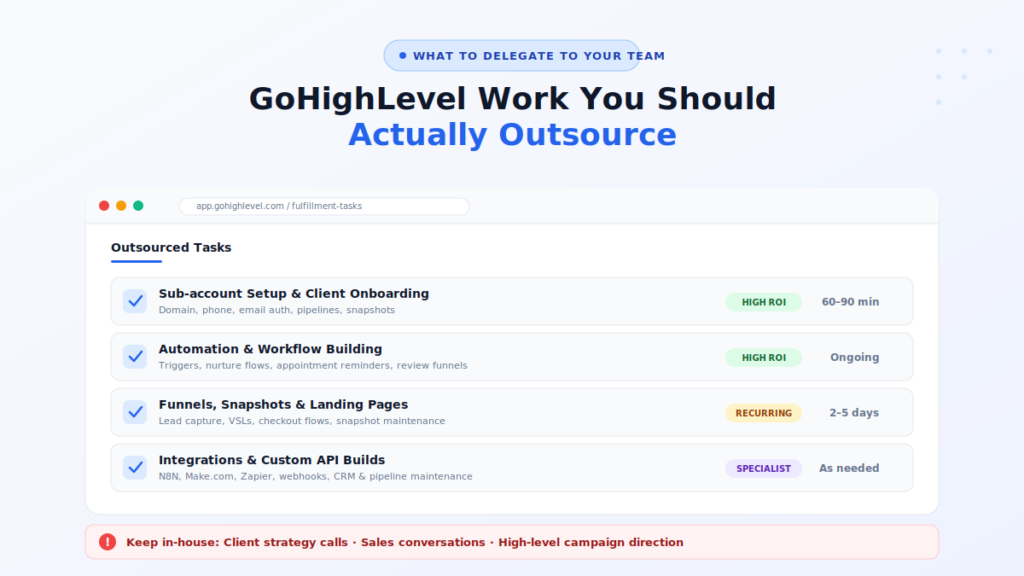
Sub-account setup and client onboarding. This is the highest-leverage task to outsource first. Every new client requires domain configuration, phone provisioning, email authentication, pipeline creation, custom field setup, and snapshot deployment. Done manually by an agency owner, this takes 4 to 8 hours per client. Done by a trained GHL specialist using a mature onboarding checklist, it takes 60 to 90 minutes.
Automation and workflow building. Trigger-action flows, multi-step sequences, appointment reminders, review funnels, no-show recovery, lead nurturing by source. This is where agencies leak the most revenue automations that look built but do not fire correctly, or get half-finished and forgotten. A dedicated builder keeps these airtight.
Funnel and landing page builds. Lead capture pages, VSL pages, checkout flows, booking pages. These are straightforward production tasks that do not need agency-owner time. Any competent GHL specialist should be able to execute on a wireframe and copy within 2 to 5 days per funnel.
Snapshot development and maintenance. For agencies running more than 3 clients in the same niche, a well-built snapshot library cuts new client setup time by 70 to 80 percent. But snapshots decay GHL updates break them, niche best practices evolve, client feedback surfaces improvements. Maintaining snapshots is a permanent background task, not a one-time project.
Ongoing CRM and pipeline maintenance. Contact cleanup, stage accuracy, duplicate merging, tagging hygiene. Agencies that skip this end up with reporting garbage inside 6 months. The fix is cheap when done weekly and painful when done annually.
Integrations and custom builds. N8N workflows, Make.com scenarios, Zapier connections, webhook handling, custom API calls. This is where generalist VAs fall short you need actual automation engineers, not GHL admins. This is one of the strongest arguments for a fulfillment partner over a single VA.
Client support and ticket handling. Once your agency has 5+ SaaS clients, support tickets become a real load. White-labeled support handled by a specialist team is usually more effective than the agency owner trying to fit it in between sales calls.
What you should not outsource immediately: strategic calls with clients, sales conversations, high-level campaign strategy, and anything requiring direct context about your client’s business goals. Those belong to you until you build the systems that let someone else hold them reliably.
What Slows Down Your Outsourcing Results
Understanding what causes delays is as valuable as understanding the process itself. These are the most common reasons outsourced GoHighLevel work underperforms or takes longer than expected.
Unclear scope and expectations. The number one killer. Agencies hand off work with vague instructions (“build a funnel for this client”) and then get frustrated when the output does not match their mental picture. Clear SOPs, written briefs, and reference builds solve this. If you do not have documentation, expect the first 3 to 4 weeks of any outsourcing relationship to be slow.
Generalist VAs handling technical GHL work. A VA who “knows GoHighLevel” is not the same as a specialist. Generalists build things that technically work but break under real usage. This shows up later as client complaints, missed automations, and rebuilds that cost more than the original build would have.
No snapshot library. Agencies that do not have standardized snapshots force every new client to be built from scratch, which wastes specialist time and creates inconsistency across the client base. If your outsourcing partner does not build and maintain snapshots, that is a red flag.
Client access friction. Slow or inconsistent access to GHL sub-accounts, missing API credentials, and unclear permission structures all cause delivery delays. Agencies that set up clean agency-level access from day one see 30–40% faster turnaround than agencies that scramble to share access per task.
Over-communication or under-communication. Some agency owners message freelancers and VAs 40 times a day and then wonder why the work is slow. Others disappear for two weeks and wonder why nothing got built. The right cadence is asynchronous daily updates plus one scheduled sync per week.
What Speeds Up Your Outsourcing Results
Several factors within your control meaningfully improve both speed and quality.
Working with a GHL-native partner, not a generic VA agency. This is the single biggest speed lever. GHL-native teams know the platform’s quirks, current editor preferences, and update cycles. Generic VA agencies train their people on GHL as one tool among many, and the depth is not there.
Documented SOPs from day one. Even rough SOPs outperform no SOPs. A Loom video of how you build a funnel, a Google Doc listing your tagging conventions, a simple snapshot template these accelerate onboarding dramatically.
Clear client intake forms. Your outsourcing partner should receive a filled-out intake form for every new client: niche, domain, brand colors, integrations needed, existing tools, phone requirements, and preferred pipeline structure. This cuts back-and-forth by 60–70%.
Weekly async reporting, not daily check-ins. Ask your partner for a short written weekly summary: what was built, what is in progress, what needs your input. This replaces 20 reactive check-in messages with one structured update.
Starting with one isolated client build as a trust test. Do not hand over your entire client base on day one. Run one complete build through the partner first snapshot deployment, funnel, automations, reporting. Evaluate the output. Then scale.
How to Vet a GoHighLevel Outsourcing Partner
The hiring process for outsourced GHL work is where most of the long-term outcome is determined. These are the screens that actually matter.
Depth of platform experience. Anyone can claim GHL knowledge. Push deeper. Ask specific questions: how do you deploy a snapshot across three new sub-accounts? How do you configure A2P for SMS compliance? What is your process for diagnosing a broken workflow? The quality of their answers separates real operators from people who watched a YouTube tutorial.
Number of sub-accounts managed. Ask how many active GHL sub-accounts their team currently manages. Anything below 50 is a red flag for an agency-focused partner. Real fulfillment teams typically manage hundreds.
Team composition. A single GHL specialist cannot cover automation, design, copy, and reporting at senior level. Ask what roles are on the team and how they collaborate. A fulfillment partner with a project manager, CRM lead, funnel designer, and integrations engineer working in concert will always outperform a lone operator.
White-label discipline. If you need client-facing work done under your brand, the partner’s team must operate with strict white-label protocols no branded signatures, no accidental “team@their-domain” emails to your clients, no visible watermarks. Ask how they handle this. If the answer is vague, keep looking.
Turnaround commitments. Reliable partners commit to specific timelines per task type. Funnel build in 3 business days. Automation flow in 48 hours. Snapshot deployment in 24 hours. Vague “we will get to it” responses signal a team without real capacity discipline.
Onboarding speed. If it takes a partner more than 72 hours to get you matched and started, they are overbooked or disorganized. Good fulfillment operations onboard within 48 hours.
What Happens After You Fully Outsource GHL
The handoff is the start of a new phase, not the end of the work. Agencies that do not understand this either get frustrated in week two or sabotage the partnership by inserting themselves where they do not belong.
The first 30 days are calibration. Your partner is learning your preferences, building SOPs from your existing work, and catching the small inconsistencies in your setup. Expect a few corrections in week one, fewer in week two, and near-zero by week four. If corrections are still happening in month three, the partner is not the right fit.
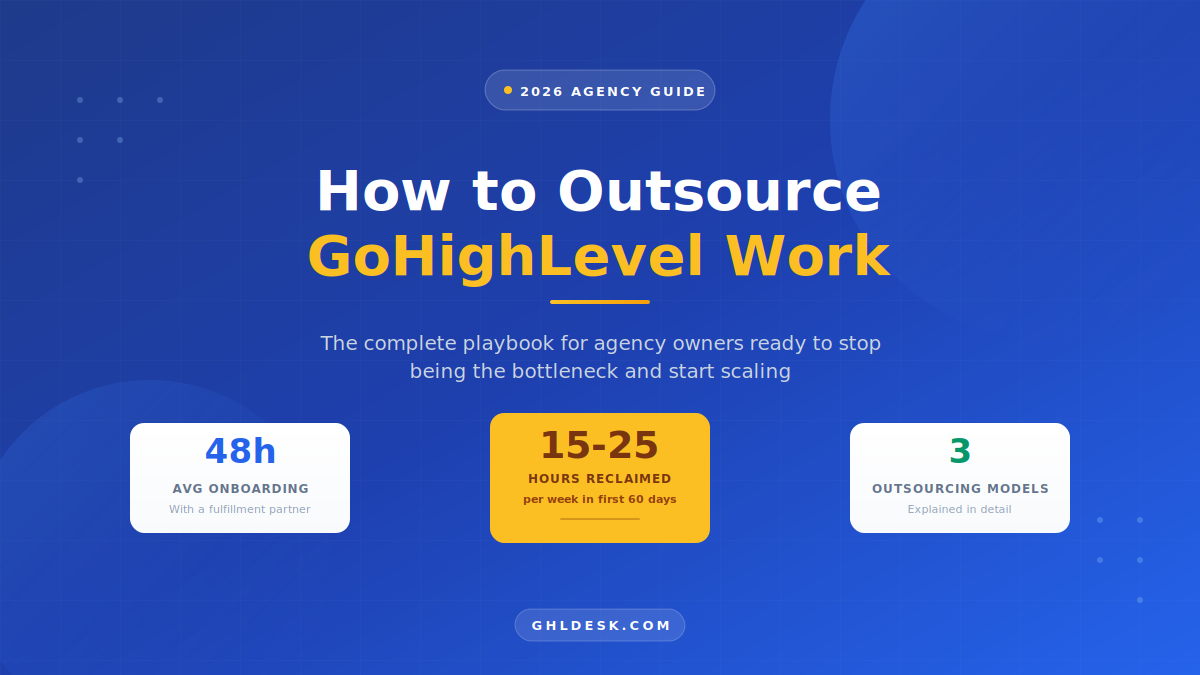
Your calendar opens up faster than expected. Agencies typically reclaim 15 to 25 hours per week in the first 60 days. Most agency owners do not have a plan for what to do with that time and fall back into fulfillment by habit. Plan the sales activity, client strategy work, or product development that will fill the reclaimed hours before you outsource, not after.
Client quality usually improves. Clients do not notice your fulfillment partner exists. They notice that things get built faster, automations stop breaking, and reports arrive on time. Retention typically improves within 90 days because clients feel the operational stability.
Your role shifts. You stop being the builder and become the director. Your job becomes writing briefs, approving outputs, handling strategic conversations, and closing new business. The agencies that succeed with outsourcing embrace this shift quickly. The ones that fail keep sneaking back into the GHL workflow builder at midnight.
How GHL Desk Handles Outsourced GoHighLevel Fulfillment
For agency owners who qualify, GHL Desk’s standard onboarding from engagement to active fulfillment is 48 hours. This is significantly faster than most providers in the space for a few specific reasons.
Every agency begins with a free strategy call a 30-minute conversation that maps your current client base, fulfillment load, and the exact GHL work that is slowing you down. If we are not the right fit, we tell you that directly.
For qualifying agencies, we assign a dedicated team based on your service mix. Every specialist has a minimum of 3 years of GoHighLevel experience and has delivered builds across hundreds of agency sub-accounts. Our team covers GHL automations, funnel builds, N8N workflows, CloseBot AI, SaaS snapshot development, and full client support.
Pricing starts at $150 for a 5-hour pay-as-you-go block for agencies testing the partnership, and scales to full dedicated teams at $2,497 per month for agencies ready to hand off fulfillment entirely. All plans are white-label by default your clients only ever see your brand.
Book a free strategy call at ghldesk.com/book-a-call or view team plans at ghldesk.com/hire-a-team.
Frequently Asked Questions
Outsourcing GoHighLevel work means handing off GHL-related tasks such as sub-account setup, automations, funnels, snapshots, integrations, and ongoing platform maintenance, to an external specialist or team instead of doing it yourself. For agency owners, this typically means hiring a GHL VA, a fulfillment partner, or a white-label team that operates under your brand while delivering work to your clients.
Costs vary by model. A freelancer or solo VA typically costs $300 to $1,500 per month. A dedicated GHL VA through a sourcing agency runs $600 to $2,000 per month. A white-label fulfillment partner with a full team usually sits between $997 and $2,497 per month. Enterprise-level fulfillment scales beyond that. The right model depends on your client volume, margin structure, and how white-label your operation needs to be.
If you have 1 to 3 clients and limited budget, a GoHighLevel VA is a reasonable start. If you have 8 or more clients, are growing fast, or need multiple skill sets like GHL, design, copy, and integrations, a white-label fulfillment agency almost always delivers better ROI. The VA model caps out because one person cannot cover every specialist role an agency needs. A fulfillment agency gives you a full team without the overhead of hiring them yourself.
Almost everything technical: sub-account setup, snapshot deployment, workflow and automation building, funnel and landing page creation, CRM and pipeline maintenance, integrations like N8N, Zapier, Make, and webhooks, SaaS mode configuration, reporting setup, and ongoing client support. The tasks you should keep in-house are strategic calls with clients, sales conversations, and high-level campaign strategy, anything that requires direct business-context with your client.
With a specialist white-label fulfillment partner, onboarding typically takes 24 to 72 hours, and full operational handoff is complete within 2 to 4 weeks. With a GHL VA from a sourcing agency, expect 2 to 6 weeks of onboarding and full independence by week 8 to 12. With a freelancer, reliable onboarding into your workflow usually takes 4 to 8 weeks of back-and-forth.
With the right partner, yes, 100%. A proper white-label fulfillment partner operates entirely under your brand: no branded signatures, no “team@their-domain” emails to your clients, no visible watermarks on deliverables. Your clients never know the fulfillment team exists. Freelancers and VA agencies can also be white-labeled, but discipline varies, so ask specifically about their white-label protocols before signing.
Ask specific technical questions: how they deploy snapshots across multiple sub-accounts, their A2P SMS compliance process, their workflow debugging approach, and how they handle SaaS mode setup. Ask how many active sub-accounts their team currently manages, where below 50 is a red flag for an agency-focused partner. Ask to see sample builds and check their team composition. Real fulfillment operations have GHL specialists, designers, project managers, and integrations engineers, not a single generalist.
Most agencies reclaim 15 to 25 hours per week within the first 60 days of properly outsourcing GHL. That reclaimed time, when redirected to sales and client strategy, typically pays for the outsourcing investment within the first month. The compounding benefits show up within 90 days: faster client onboarding, fewer broken automations, improved client retention, and the ability to take on more clients without more personal workload.
Yes, and SaaS mode agencies typically benefit the most from outsourcing. SaaS mode requires disciplined sub-account creation, rebilling configuration, snapshot deployment at scale, and ongoing support, all tasks that compound as the agency adds clients. A specialist fulfillment partner handles SaaS mode infrastructure, white-label support tickets, and snapshot libraries so the agency owner can focus on client acquisition instead of platform operations.
The fastest path is a specialist fulfillment partner that onboards within 48 hours, has pre-vetted GHL specialists ready to assign, and operates with mature white-label protocols from day one. Skip the freelancer phase entirely if your agency already has 5 or more clients, because the time lost managing inconsistent freelancers typically costs more than jumping directly to a proper fulfillment team. GHL Desk’s free strategy call identifies within 30 minutes whether a fulfillment partnership fits your agency’s current stage.