⚡ Quick Answer
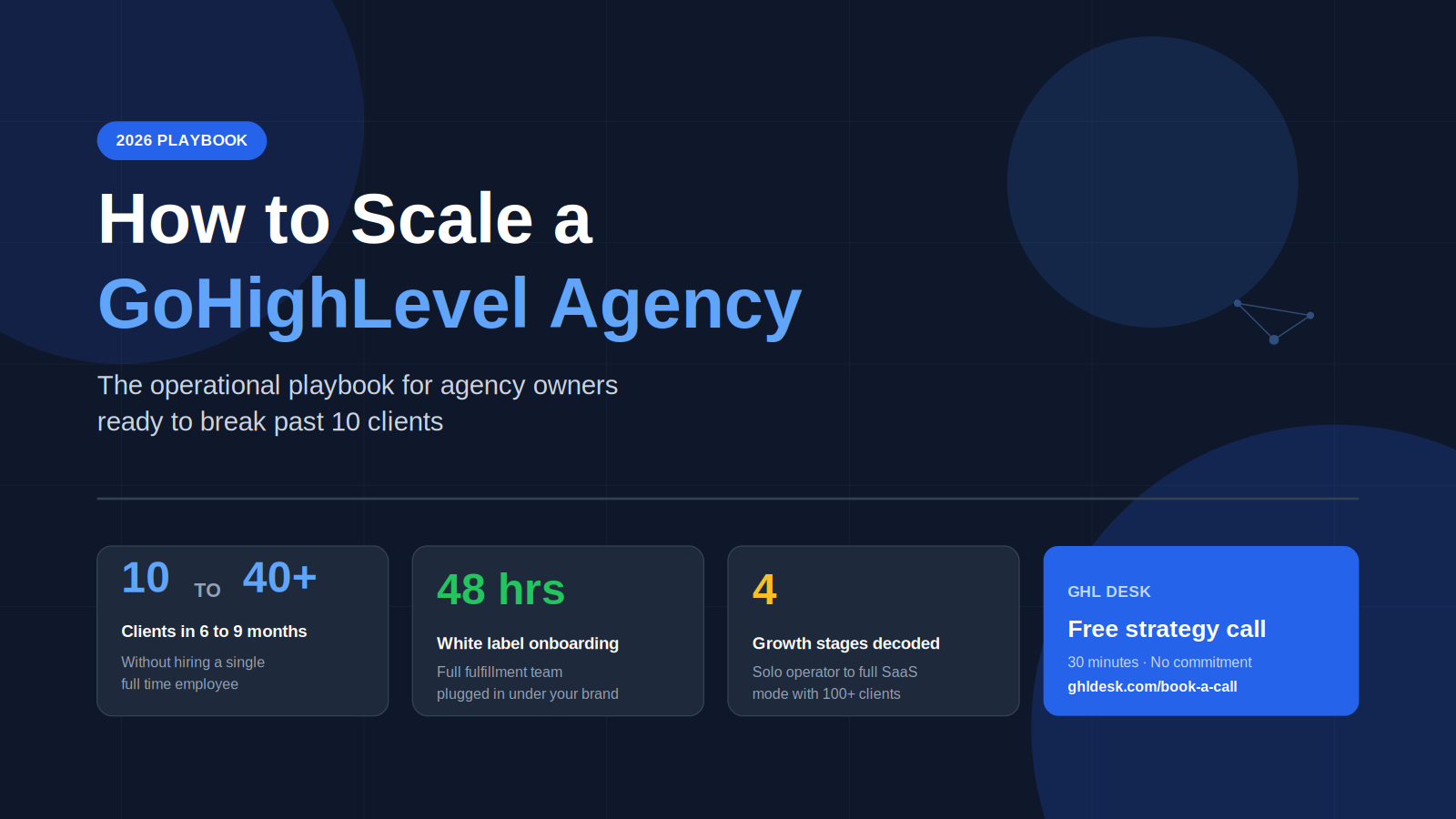
Scaling a GoHighLevel agency in 2026 is not about adding more clients. It is about removing the fulfillment bottleneck before you add them. Most agencies plateau between 8 and 15 clients because the owner becomes the operations team. The three scaling levers that actually work are productized fulfillment, standardized snapshot libraries, and outsourced technical delivery. With the right operational infrastructure, a GHL agency can move from 10 clients to 40+ clients in 6 to 9 months without hiring a single full-time employee. GHL Desk plugs into growing agencies as a white-label fulfillment partner in 48 hours so agency owners can focus purely on sales, strategy, and recurring revenue growth.
If you are running a GoHighLevel agency in 2026, you already know the ceiling is real. You sign a new client and spend the next week buried in sub-account setup, broken automations, and funnel fixes. You stop selling because fulfillment eats every hour. You hit 8 clients, then 12, then you stop growing entirely because one more client means one more week of your life gone.
Most articles about scaling GHL agencies focus on SaaS mode, recurring revenue, or price anchoring. Those are outcomes, not the bottleneck. The real question is operational: how do you actually deliver at 25, 50, or 100 clients without becoming a full-time technical operator? This guide answers that directly, from an operational angle, for agency owners who already know the theory and just want the playbook that works in 2026.
Why Most GoHighLevel Agencies Plateau at 10 Clients
There is a very specific ceiling in the GHL agency world, and it sits between 8 and 15 clients. Almost every agency owner hits it, and most stay there for years. The reason is not sales. The reason is that the platform itself demands a full-time operator, and below a certain revenue level, that operator is always the agency owner.
Each active client on GHL generates a predictable workload. Sub-account maintenance, pipeline cleanup, automation monitoring, funnel tweaks, reporting, client-facing platform support, snapshot updates, and integration fixes. For one client, that workload is 2 to 5 hours per week. For ten clients, it is 20 to 50 hours per week. Somewhere in that range, the agency owner runs out of time, stops selling, and growth flatlines.
The traditional fix is hiring. An agency owner hires a VA or in-house specialist, trains them for 2 to 3 months, and finally breathes. Then growth resumes. Then the next plateau hits at 25 clients. Then they hire again. Each hiring cycle takes 60 to 90 days, costs significant money, and forces the owner into a manager role they never wanted.
The agencies that break through this ceiling in 2026 do not hire their way out. They systemize their way out. They build operational infrastructure that scales without linear headcount growth, and they outsource the fulfillment layer entirely so the team that delivers GHL work is not their problem to recruit, train, or manage.
The Four Growth Stages of a GoHighLevel Agency
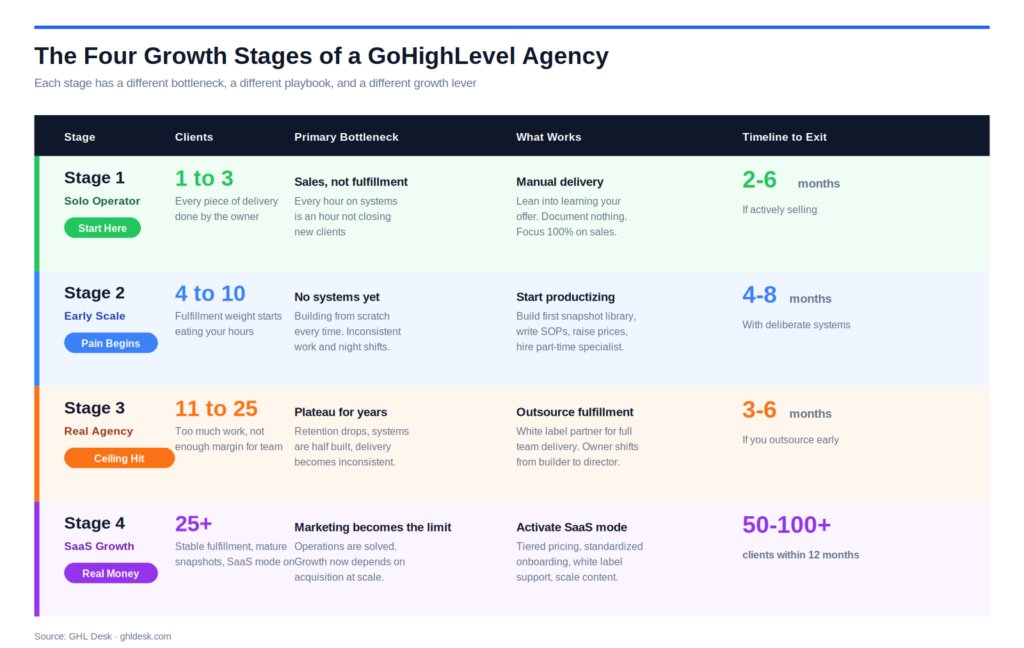
Every GHL agency moves through four stages, and each stage has a different primary bottleneck. Skipping a stage or applying Stage 3 tactics at Stage 1 is one of the most common reasons agencies stall.
Stage 1 applies if you are running 1 to 3 clients and doing every piece of delivery yourself.
Stage 2 applies if you have 4 to 10 clients and have started to feel the fulfillment weight but have not yet built systems.
Stage 3 applies if you have 11 to 25 clients and are actively hitting the operational ceiling where something must change.
Stage 4 applies if you have 25+ clients, are running SaaS mode, and are scaling to a real software business.
Each stage has a specific playbook, a specific growth lever, and a specific failure mode. Below is what actually works at each one.
Stage 1: Solo Operator (1 to 3 Clients)
This is the earliest stage and the stage where agencies most often misdiagnose their problem. At 1 to 3 clients, the bottleneck is not fulfillment. It is sales. Every hour spent building snapshots, creating SOPs, or researching white-label providers is an hour not spent closing.
What actually works. Lean into manual delivery. Build everything yourself. Pay attention to every single client interaction because you are learning the shape of your offer. Document nothing yet. The goal at this stage is pattern recognition, not systemization.
What to spend money on. Lead generation, not infrastructure. Paid ads, cold outreach, or referral engines. GHL subscription on the Unlimited plan ($297/month). Nothing else.
What to avoid. Hiring a VA. Buying someone else’s snapshot library. Trying to run SaaS mode. Building a course. Starting a YouTube channel. None of these accelerate growth at this stage, and all of them consume time you need for sales.
Realistic timeline to exit this stage. 2 to 6 months if you are actively selling. Agencies that stay at 2 clients for a year almost always have a sales problem, not a fulfillment problem.
Stage 2: Early Scale (4 to 10 Clients)
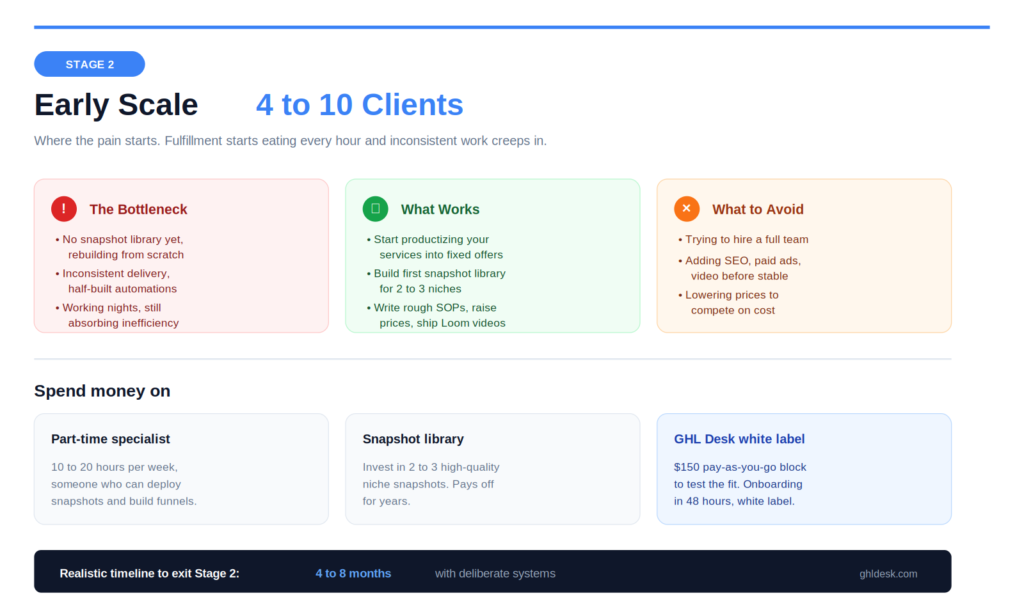
This is where the pain starts. You stop being able to build everything from scratch for every client because there is no time. You start shipping inconsistent work. Automations get half-built. Clients complain. You start working nights.
What actually works. Start productizing. Build your first snapshot library covering the 2 to 3 niches you have landed in. Write rough SOPs, even if they are just Loom videos, so the same task does not take new effort every time. Raise your prices, because at this stage you are undercharging and absorbing the inefficiency through personal hours.
What to spend money on. A part-time GHL specialist, not a generalist VA. Someone who can deploy snapshots, build funnels, and handle standard automation work. At this volume, an outsourced specialist at 10 to 20 hours per week is more cost-effective than a full-time hire.
What to avoid. Trying to hire a team. Adding service lines like SEO, paid ads, or video before your GHL fulfillment is stable. Lowering prices to compete. Building a custom CRM dashboard nobody asked for.
Realistic timeline to exit this stage. 4 to 8 months if you build systems deliberately. Agencies that stay here usually have no snapshot library and are rebuilding from scratch for every new client.
Stage 3: Real Agency (11 to 25 Clients)
This is the ceiling where most agencies live for years. You have too much work for yourself, not enough margin for a full team, and your systems are half-built. Client retention starts to suffer because delivery becomes inconsistent. You start dreading your own inbox.
What actually works. Full outsourced fulfillment. At this stage, you need a team, but building that team internally is slow, expensive, and risky. A white-label fulfillment partner gives you a full team without the hiring overhead. Your job shifts from builder to director. You write briefs, approve outputs, and hold strategic conversations with clients.
What to spend money on. A dedicated white-label fulfillment partner or a full outsourced team covering CRM, automation, funnels, and support. This typically costs $997 to $2,497 per month and produces 40 to 160 hours of delivery capacity per month, which is the equivalent of 1 to 4 full-time employees at a fraction of the cost.
What to avoid. Hiring multiple freelancers and trying to coordinate them yourself. Offering new services you cannot deliver. Lowering your prices to close more deals. Taking on enterprise clients before your systems are ready.
Realistic timeline to exit this stage. 3 to 6 months if you commit to outsourced fulfillment early. Agencies that try to hire in-house typically stall here for 12 to 24 months.
Stage 4: SaaS Growth (25+ Clients)
This is where the real money is, and where the agency model transitions into a software business. You have stable fulfillment, predictable delivery, and your systems work without you watching every step. Now the goal is recurring revenue growth and reducing service delivery per client.
What actually works. SaaS mode activation. Standardized onboarding that takes hours, not days. Tiered pricing that pushes clients into self-service for basic needs and reserves your team for high-value work. A mature snapshot library specific to your niches. White-label support handling the platform-level questions so your team only touches strategic requests.
What to spend money on. SaaS mode configuration (which requires real expertise to set up correctly). Stripe rebilling, Twilio, Mailgun. A white-label support layer so your fulfillment partner handles client platform questions directly. Content and paid acquisition at scale.
What to avoid. Getting distracted by new platforms. Abandoning clients who brought you to this stage. Over-customizing for single clients, which breaks your ability to scale. Rebuilding your snapshot library from scratch instead of iterating.
Realistic timeline at this stage. Agencies that hit 25 clients with mature systems typically reach 50 to 100 clients within 12 months. The bottleneck shifts from operations to marketing and sales.
The Three Scaling Levers That Actually Work
Every GHL agency that scales past 25 clients in 2026 uses the same three levers. Agencies that skip any of them either stall or burn out.
Productized delivery. Your services need to be packaged into clear, repeatable offers. Not hourly work. Not custom quotes for every client. Specific deliverables at specific prices with specific timelines. A GHL agency selling “marketing automation services” will always struggle. An agency selling “30-day GHL setup with 5 automations and 3 funnels for $3,500” scales.
Outsourced fulfillment. Delivery work needs to happen without the owner doing it or managing it. This is non-negotiable past Stage 2. The options are in-house hiring (slow, expensive, risky) or white-label fulfillment (fast, flexible, predictable). Most successful agencies in 2026 run with outsourced fulfillment as the primary layer and a small internal team for strategy and client relationships.
Recurring revenue systems. One-off project revenue is unpredictable and creates constant pressure to close new clients. Monthly retainers, SaaS subscriptions, and managed service plans stabilize the business. Even agencies that start with project work should have a clear path to recurring revenue within 6 months, whether that is GHL SaaS mode, monthly management retainers, or white-label subscriptions billed under their brand.
What Kills GoHighLevel Agency Growth
Understanding what stops agencies from scaling is as valuable as understanding what works. These are the most common growth killers in 2026.
The owner as the only operator. When every decision, every build, and every fix goes through one person, the business cannot grow past that person’s capacity. This is the single biggest cause of agency plateau.
No snapshot library. Agencies that build every client from scratch burn 8 to 20 hours on onboarding that a mature snapshot deploys in 60 to 90 minutes. Over 10 clients, that is the difference between a working agency and one that cannot keep up.
Freelancer roulette. Hiring cheap freelancers from Upwork or Fiverr for complex GHL work almost always results in broken builds, inconsistent quality, and rework. Every agency owner reading this has a story about a freelancer who disappeared or produced work that had to be redone entirely.
Over-diversification too early. Adding SEO, paid ads, and video services before GHL fulfillment is stable dilutes focus and breaks delivery. Agencies that do fewer things at a higher quality level scale faster than agencies that try to do everything.
Pricing based on hours. Selling GHL work by the hour caps revenue at the hours available. Productized pricing breaks this ceiling because delivery time reduces over the lifetime of an agency while pricing stays the same.
Ignoring retention. Most GHL agencies obsess over acquisition and ignore retention. A client lost at month three costs more than a client never signed, because the cost of acquisition is already spent. Improving retention by 20 percent is usually easier and more profitable than increasing acquisition by 20 percent.
What Accelerates GoHighLevel Agency Growth
Several specific actions reliably compress the scaling timeline.
Niching down to 1 or 2 verticals. Agencies that serve dentists or real estate or home services exclusively scale 3 to 5 times faster than generalist agencies. Specialization compounds because each client teaches you how to serve the next one faster, and word of mouth within an industry accelerates acquisition.
Building a mature snapshot library early. Even at Stage 2, investing in 2 to 3 high-quality niche-specific snapshots pays off immediately and continues paying off for years.
Outsourcing the fulfillment layer. Agencies that outsource GHL delivery at Stage 3 typically hit Stage 4 within 6 to 9 months. Agencies that try to build the team internally usually take 18 to 24 months to reach the same level, if they get there at all.
Tight client onboarding. Clients who are onboarded well in the first 30 days retain 60 to 80 percent longer than clients who have rough starts. A structured onboarding sequence with automated welcome flows, clear expectations, and fast first wins is one of the highest-ROI investments in the entire agency.
Activating SaaS mode at the right time. SaaS mode is powerful, but only after your fulfillment is stable. Agencies that try SaaS mode at Stage 2 usually fail because they cannot support the clients it attracts. Agencies that activate it at Stage 4 often double revenue within 12 months.
Weekly client reporting without manual effort. Automated dashboards and reports that deliver weekly without human touch build client confidence, reduce churn, and eliminate a recurring manual task. Every agency past Stage 2 should have this running.
How GHL Desk Helps Agencies Scale
For agency owners at Stage 2, 3, or 4, GHL Desk operates as a white-label fulfillment partner that removes the fulfillment bottleneck entirely. Onboarding for qualifying agencies is 48 hours, not weeks.
Every engagement starts with a free strategy call, a 30-minute conversation that maps your current client base, fulfillment load, and the specific bottleneck blocking your next growth stage. If we are not the right fit, we tell you directly.
For qualifying agencies, we assign a dedicated team covering GHL specialists, automation builders, funnel designers, N8N engineers, CloseBot AI experts, and client support. Every specialist has a minimum of 3 years of hands-on GoHighLevel experience and has delivered across hundreds of agency sub-accounts.
Pricing starts at $150 for a 5-hour pay-as-you-go block for agencies testing the fit, scales to $997/month for a shared team covering 40 hours of work across 3 roles, and goes up to $2,497/month for a dedicated team of 6 specialists with unlimited hours within scope. Enterprise options are available for agencies past 50 clients running SaaS mode at scale. Every plan is white-label by default. Your clients only ever see your brand.
Book a free strategy call at ghldesk.com/book-a-call or view team plans at ghldesk.com/hire-a-team.
.gd-faq{font-family:inherit;max-width:780px;margin:2rem auto} .gd-faq-h{font-size:26px;font-weight:700;color:#111;margin:0 0 1.25rem;padding-bottom:0.75rem;border-bottom:2px solid #2563eb} .gd-item{border:1px solid #e5e7eb;border-radius:10px;margin-bottom:8px;overflow:hidden} .gd-btn{width:100%;background:#fff;border:none;padding:16px 20px;display:flex;justify-content:space-between;align-items:center;cursor:pointer;text-align:left;gap:1rem} .gd-btn:hover{background:#f9fafb} .gd-qt{font-size:15px;font-weight:600;color:#111;line-height:1.4;font-family:inherit} .gd-ic{width:26px;height:26px;border-radius:50%;background:#f3f4f6;border:1px solid #d1d5db;display:flex;align-items:center;justify-content:center;flex-shrink:0;transition:all 0.2s} .gd-ic svg{transition:transform 0.25s ease} .gd-item.open .gd-ic{background:#dbeafe;border-color:#93c5fd} .gd-item.open .gd-ic svg{transform:rotate(45deg)} .gd-body{max-height:0;overflow:hidden;transition:max-height 0.3s ease} .gd-inner{padding:0 20px 16px;border-top:1px solid #f3f4f6} .gd-inner p{font-size:14.5px;color:#4b5563;line-height:1.8;margin:12px 0 0;font-family:inherit} .gd-inner strong{color:#111;font-weight:700} .gd-item.open .gd-body{max-height:600px}Frequently Asked Questions
Most GHL agencies move from Stage 1 (1 to 3 clients) to Stage 4 (25+ clients) in 18 to 36 months if they build operational systems deliberately. Agencies that stall in Stage 3 often stay there for years because they try to hire in-house instead of outsourcing fulfillment. With a white-label fulfillment partner handling delivery, the timeline from 10 to 40 clients compresses to 6 to 9 months.
At 10 clients, the weekly fulfillment workload is typically 20 to 50 hours, which consumes the agency owner’s full working week. Sales stops, growth stalls, and the agency gets stuck. The plateau is operational, not a sales problem. Breaking it requires either building an in-house team (slow and expensive) or outsourcing the fulfillment layer (fast and flexible).
SaaS mode works best after Stage 3, when your fulfillment is stable and your snapshot library is mature. Activating SaaS mode at Stage 1 or 2 usually fails because the agency cannot support the volume of clients it attracts. The right time is when you have 15 to 25 stable clients, a reusable snapshot library, and either an outsourced or in-house team handling platform-level support.
For most agencies in 2026, outsourced fulfillment is the faster path to scale. Building an in-house team takes 6 to 12 months, requires significant capital, and creates HR overhead. A white-label fulfillment partner delivers the same team output in 48 hours with no hiring, no training, and no management load. In-house hiring makes sense at Stage 4 for strategic roles, not delivery.
With solo operations, the realistic cap is 8 to 15 clients. With a small internal team, 25 to 40 clients. With a mature outsourced fulfillment operation plus SaaS mode, 100+ clients is achievable. The number depends on fulfillment capacity, snapshot maturity, and how much work is delivered by automation versus manual effort.
The fastest-to-productize GHL services are 30-day CRM setup packages, niche-specific snapshot deployments, monthly automation management retainers, and SaaS mode launch packages. Productize the work you deliver most often, set fixed pricing, define the exact deliverables, and commit to fixed timelines. Custom hourly work does not scale.
The core scaling investment is the fulfillment layer. Outsourced fulfillment typically costs $997 to $2,497 per month for a full team, compared to $8,000 to $15,000 per month for an equivalent in-house team plus 90 days of hiring and training time. Additional costs include GHL Agency Pro ($497/month for SaaS mode), acquisition spend, and standard business overhead. Most agencies reach profitability at Stage 3 within 60 days of outsourcing fulfillment.
Diversifying service lines too early. Agencies at 8 to 10 clients often add SEO, paid ads, video, and social media before their core GHL fulfillment is stable. This dilutes focus, breaks delivery quality, and increases churn. The fix is to stabilize GHL delivery first, then add adjacent services only after fulfillment runs without the owner’s direct involvement.
Yes. A mature snapshot library is not optional past Stage 2. Snapshots cut new client setup time by 70 to 80 percent and create consistency across the client base. An agency with 3 high-quality niche snapshots can onboard a new client in hours instead of days. Most fulfillment partners, including GHL Desk, build and maintain snapshot libraries as part of the ongoing engagement.
The fastest path is layering monthly management retainers on top of project work, typically $297 to $997 per client per month. Every new project-based client gets offered an ongoing management retainer at closing. Within 6 months, most agencies can convert 40 to 60 percent of project clients into monthly retainers. After that, SaaS mode becomes the next layer of recurring revenue at Stage 4.
The fastest path is: niche down to 1 or 2 verticals, productize your offer with fixed pricing, outsource fulfillment to a white-label partner at Stage 2 instead of waiting until Stage 3, and layer recurring revenue from month one. Agencies that follow this path typically reach 25 clients in 9 to 12 months instead of the typical 24 to 36 months. GHL Desk’s free strategy call identifies within 30 minutes which growth lever is missing from your current setup.