⚡ Quick Answer
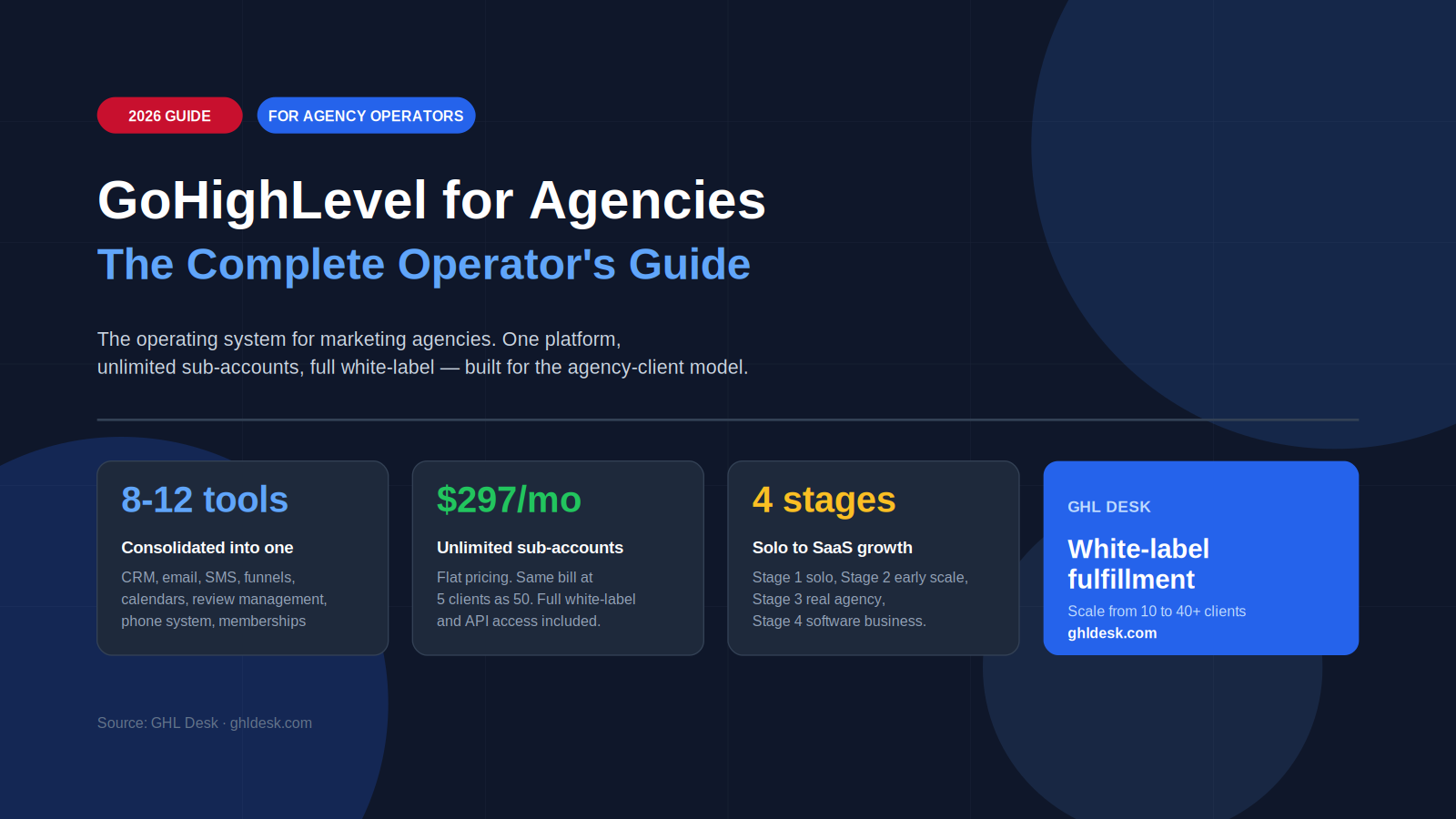
GoHighLevel is the all-in-one CRM, marketing automation, and white-label SaaS platform built specifically for marketing agencies. For agencies, GoHighLevel replaces 8 to 12 separate tools (CRM, email, SMS, funnels, calendars, review management, reputation, membership sites, phone system) into one platform priced at $97 to $497 per month. The three plans are Starter ($97/mo, up to 3 sub-accounts), Unlimited ($297/mo, unlimited sub-accounts and white-label), and Agency Pro ($497/mo, SaaS mode with rebilling). Agencies use GoHighLevel to onboard clients into isolated sub-accounts, deploy pre-built snapshots for fast setup, automate lead-to-close workflows, and resell the platform as branded software. Most agencies plateau at 8 to 15 clients because they lack the fulfillment infrastructure to scale further. GHL Desk plugs into agencies as a white-label fulfillment partner in 48 hours so agency owners can scale from 10 to 40+ clients without hiring internally.
GoHighLevel (also called GHL or HighLevel) is the operating system for marketing agencies in 2026. Not because it is the prettiest CRM, not because it has the deepest reporting, and not because it wins every feature comparison. It wins because it is the only platform built from the ground up for a specific business model: one agency managing marketing operations for dozens of client businesses simultaneously. Every other CRM was designed for a single business managing its own marketing. GoHighLevel was designed for the agency-client model, and that architectural decision compounds into every advantage the platform has.
This guide is the complete 2026 operator’s playbook for GoHighLevel, written for actual agency owners rather than beginners evaluating tools. If you already know the basics of what GHL is and want to understand how agencies actually use it to build scalable businesses, this is the guide for you. What follows covers the platform’s architecture, the four growth stages of a GHL agency, the operational infrastructure that determines whether you scale or plateau, and the specific setup decisions that separate agencies running at 30 clients from agencies stuck at 10.
What GoHighLevel Actually Is (For Agencies)
GoHighLevel is a single platform that consolidates every marketing tool an agency needs to serve clients into one dashboard. That includes the CRM for managing contacts, the workflow builder for automation, the funnel and website builder for landing pages, the calendar for appointment scheduling, the phone system for calls and SMS, the email platform for campaigns, the reputation management layer for review collection, the membership site builder for gated content, and the AI layer for conversation and voice agents. Everything an agency needed 8 different tools to deliver in 2018 now runs inside one platform in 2026.
The platform was founded in 2018 by Shaun Clark and is now used by over 1 million businesses globally, with over 600,000 active users and more than 4.6 billion contact records under management. GoHighLevel processes over 1 billion API calls per day and powers more than 30 million transactions daily across its customer base. The scale of the platform matters because it signals long-term stability and continued investment in the product.
The critical distinction between GoHighLevel and every other CRM is the multi-tenant architecture. A HubSpot account is one account for one business. A GoHighLevel account is an agency-level account that contains unlimited sub-accounts, each of which is a fully isolated environment for one client business. When you serve 20 clients, you have 20 sub-accounts, each with its own contacts, pipelines, workflows, funnels, and reporting. Data never crosses. Access is controlled at the sub-account level. And every sub-account can be white-labeled to appear as if it belongs to a different brand entirely.
Why GoHighLevel Beats Every Other CRM for Agencies
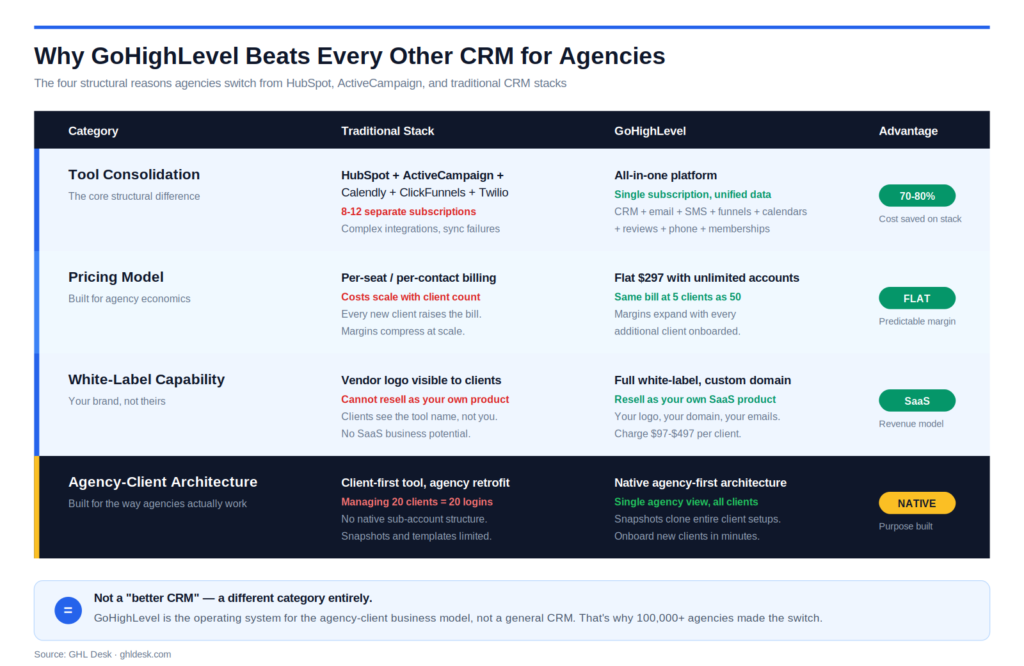
Every serious CRM comparison eventually comes back to the same question: are you evaluating for a single business or for an agency serving many businesses? For a single business, HubSpot wins on depth, Salesforce wins on customization, and ActiveCampaign wins on email deliverability. But none of them were built for the agency model, and that shows up the moment you try to serve more than 3 or 4 clients on any of them.
Sub-account architecture. No other platform gives you unlimited isolated environments per client on a single agency subscription. HubSpot requires a separate paid seat structure for each client business. Salesforce requires enterprise-level pricing per organization. GoHighLevel gives you unlimited sub-accounts on the $297 per month Unlimited plan, which means your infrastructure cost per client trends toward zero as you scale.
White-label capability. Every client interaction under GoHighLevel appears under your agency brand. Your logo, your domain, your color scheme, your email footers. Clients log into what they believe is your proprietary software. No other CRM in this price bracket offers this level of white-label depth.
Reseller economics. With SaaS mode enabled, agencies can charge clients a monthly subscription for access to the branded software. This is not a service fee, it is a software subscription. The economics shift from selling one-time projects to selling recurring software, which is the same transition that separates struggling agencies from ones that scale into 7 figures.
Multi-channel native. Voice calls, SMS, email, Facebook Messenger, Google Business Messenger, and WhatsApp all run inside GoHighLevel workflows natively. No integration required. No separate Twilio account to manage per client. When you build a workflow that fires an SMS after a missed call and sends an email 24 hours later, it just works.
Snapshot deployment. A snapshot is a pre-built template containing pipelines, workflows, funnels, custom fields, and tags that can be deployed to any sub-account in minutes. Build a real estate snapshot once, deploy it to 15 real estate clients in 15 minutes. This is the mechanism that lets agencies scale service delivery without scaling headcount.
Agency-focused pricing. Flat pricing that does not scale with contacts, users, or client volume. Your bill at 5 clients is the same as your bill at 50 clients on the Unlimited plan. Every other CRM prices per contact or per user, which means your platform cost grows in lockstep with your revenue.
GoHighLevel Pricing and Plans in 2026
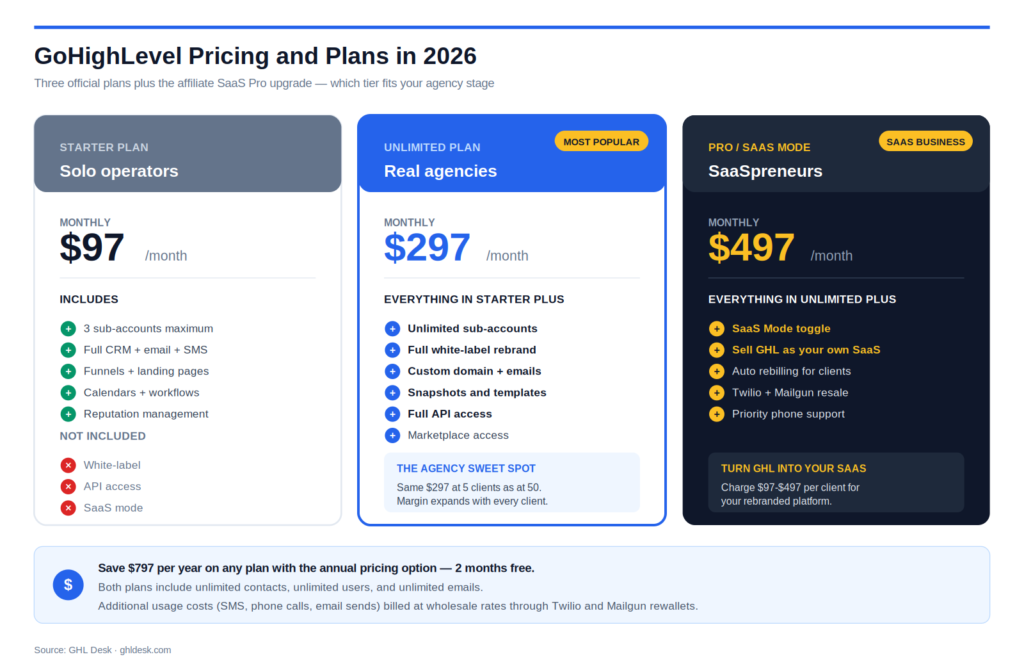
GoHighLevel has three plans in 2026, with prices that held steady from 2025. Every plan includes unlimited contacts and unlimited users. Usage fees for SMS, email, phone calls, and AI are billed separately on top of the plan through LC Phone, LC Email (Mailgun), and the AI Employee add-on.
Starter Plan at $97 per month. Limited to 3 sub-accounts. Fits solo operators and early-stage agencies with 1 to 2 clients. Includes the full CRM, funnel builder, workflow automation, calendar, phone and SMS, email, and conversation AI. Annual billing drops the effective price to roughly $81 per month. This plan is genuinely capable, and many agencies stay on it longer than they should.
Unlimited Plan at $297 per month. Unlimited sub-accounts. Full agency white-label, custom domain, agency dashboard, and API access. This is the workhorse plan for growing agencies managing 3 to 20 clients. It is the plan we recommend most agency owners start on because the sub-account limit on Starter becomes a bottleneck within the first 60 days for anyone actively selling. Annual billing drops the effective price to roughly $248 per month.
Agency Pro Plan at $497 per month. Everything in Unlimited plus SaaS mode, automated client rebilling through Stripe, and branded mobile app support. This plan exists for agencies that want to build a software revenue stream by reselling GoHighLevel access to clients as branded subscription software. Annual billing drops the effective price to roughly $414 per month.
Usage-based costs. SMS runs approximately $0.0079 per segment, email runs approximately $0.675 per 1,000 sends, phone calls run approximately $0.014 per minute, and AI features scale by conversation or voice minute. Typical agency usage adds $50 to $200 per month per sub-account depending on volume. The AI Employee add-on runs $97 per month per sub-account for unlimited AI usage, versus pay-as-you-go rates that scale by interaction.
Real cost math for a 10-client agency. Base plan at $297 per month, usage across 10 sub-accounts at $80 average per sub-account per month equals $800, no AI Employee add-on equals $0. Total platform cost around $1,097 per month for 10 clients. That is roughly $110 per client per month in platform cost. If you charge each client $497 per month as a managed retainer or $297 per month as SaaS access, gross margin lands between 78 percent and 92 percent before any fulfillment cost.
The Sub-Account Architecture That Powers Everything
The sub-account is the single most important concept in GoHighLevel. Understanding how sub-accounts work is the difference between using GoHighLevel like a CRM and using it like the agency operating system it was designed to be.
One agency, unlimited sub-accounts. Your agency account is the parent. Every client gets their own sub-account, which is a fully isolated environment. Contacts do not cross. Workflows do not overlap. Reporting is independent. A sub-account for a dental clinic looks and behaves exactly like a standalone CRM for that dental clinic, even though it lives inside your agency’s account.
Agency-level access controls. As the agency owner, you have full access to every sub-account through your agency dashboard. Your team members can be given granular access, from full agency-level access down to view-only access to specific sub-accounts. Clients can be given login access to only their own sub-account with configurable permission levels.
Snapshot deployment happens at the sub-account level. You build a snapshot in one sub-account (or in the agency-level snapshot library), then deploy that snapshot to any other sub-account. The deployment installs the pipelines, workflows, funnels, custom fields, and tags from the snapshot into the target sub-account. This is how agencies onboard new clients in 60 to 90 minutes instead of days.
Sub-account settings are independent. Each sub-account has its own business profile, timezone, phone numbers, custom domain, branding colors, and email sender addresses. This isolation is what makes white-labeling actually work. When a client logs into their sub-account, they see their own business branding (or your agency’s white-label brand), never GoHighLevel’s default.
Data segmentation is enforced at the platform level. GoHighLevel’s architecture prevents data from one sub-account from being visible in another. This matters for compliance in regulated industries like healthcare and financial services, where cross-tenant data leakage is a legal issue.
Sub-accounts scale to hundreds without performance degradation. GoHighLevel is designed to run thousands of sub-accounts per agency account without any impact on individual sub-account performance. The largest agencies on the platform run over 500 active sub-accounts on a single Unlimited or Agency Pro subscription.
Snapshots: The Most Valuable Asset in a GHL Agency
If sub-accounts are the architecture, snapshots are the operational asset that determines whether your agency scales or drowns in setup work. A snapshot is a pre-built template containing pipelines, workflows, funnels, websites, custom fields, tags, triggers, forms, calendar configurations, and email templates. Deploy a snapshot to a new sub-account, and every one of those elements installs in minutes.
What a mature snapshot contains. A real production-quality snapshot for a specific niche typically contains 8 to 12 workflows (all the standard automations covered in our workflows guide), 5 to 8 pipelines with correct stages, 20 to 40 custom fields, 30 to 60 tags with consistent naming conventions, 3 to 6 funnel templates, 4 to 8 email templates, 3 to 5 SMS templates, and calendar templates configured for the niche’s typical booking flow.
Why niche-specific snapshots outperform generic snapshots. A dental snapshot uses different messaging, appointment timing, review request flows, and pipeline structure than a home services snapshot. Generic snapshots are technically usable but produce mediocre results across every niche. The agencies that scale fastest in 2026 build 2 to 4 niche-specific master snapshots and refuse to work outside those niches.
The ROI math on snapshots. Manual setup of a fresh sub-account for a new client takes 8 to 20 hours depending on scope. Snapshot deployment for the same setup takes 60 to 90 minutes plus 2 to 4 hours of client-specific customization. That is a 70 to 80 percent time reduction per client. Across 20 new clients per year, a mature snapshot saves 150 to 300 hours of setup time. At standard agency operator rates, that is $15,000 to $45,000 in reclaimed capacity per year from a single snapshot investment.
Snapshot maintenance is a real operational cost. Snapshots decay over time. GHL updates change workflow action behavior. Niche best practices evolve. Client feedback surfaces improvements. A snapshot built in January is not the same as a snapshot in October unless someone maintains it. Most agencies underinvest in snapshot maintenance and end up with stale libraries that produce inconsistent results across the client base.
Master snapshot versus per-client customization. The correct pattern is to maintain a master snapshot per niche, deploy it to new clients, then make client-specific modifications inside their sub-account. Never edit the master snapshot with client-specific logic. When you update the master, redeploy strategically to existing clients so they benefit from improvements without breaking their custom configurations.
White-Label Mode: Running GHL as Your Brand
White-label is the feature that separates GoHighLevel from every other CRM in the same price bracket. When configured correctly, GoHighLevel disappears entirely and your agency’s brand takes over.
Custom domain configuration. You point a custom domain (like app.youragency.com) to GoHighLevel, and every login page, dashboard, and client portal loads under your domain. Your clients never see gohighlevel.com or highlevel.com in any URL.
Full visual branding. Upload your logo, set primary and secondary colors, configure email templates with your branding, customize the mobile app icon and splash screen (on Agency Pro), and replace every default GoHighLevel graphic with your own. Every visible element of the platform reflects your brand.
Custom email sender. Every outbound email from any sub-account can send from your agency’s domain rather than a shared GoHighLevel domain. Configure DKIM, SPF, and DMARC records correctly, and your email deliverability meets the same standards as any dedicated email platform.
Branded knowledge base and support. Route client support tickets to your agency’s support layer rather than GoHighLevel’s. Build a custom help center under your domain with articles specific to how your agency configures the platform.
Team member white-labeling. Your fulfillment team members appear as agency team members inside client sub-accounts, not as external users. Their profile pictures, names, and titles all reflect your agency structure.
White-label discipline in practice. Real white-label is more than the visual configuration. It requires operational discipline: your team never uses signatures that reference GoHighLevel, they never send emails from personal accounts, they use your agency email domain exclusively, they know how to answer client questions without exposing that a third-party platform exists. This is the level of white-label discipline that separates real fulfillment operations from freelancers claiming to offer white-label service.
SaaS Mode: Turning Your Agency Into a Software Company
SaaS mode is the feature on the Agency Pro plan ($497 per month) that transforms your agency from a service provider into a software company. This is where the highest-leverage GoHighLevel agencies operate in 2026.
What SaaS mode actually does. SaaS mode connects your Stripe account to GoHighLevel, lets you set custom subscription prices for sub-account access, and automates the entire billing flow. Clients sign up on your white-label signup page, pay you directly through Stripe, and get provisioned a sub-account automatically. Your platform cost stays roughly flat while your subscription revenue scales linearly with client count.
The revenue math that changes everything. At 50 clients paying $297 per month for access to your branded platform, you generate $14,850 per month in software subscription revenue. Your GoHighLevel cost is roughly $497 per month plus usage. Software gross margin lands between 90 and 95 percent. At 100 clients, monthly revenue reaches $29,700 with the same platform infrastructure.
Rebilling for usage. SaaS mode supports automated rebilling of SMS, email, phone, and AI usage back to clients at a markup. Client uses $80 in SMS in a month, you charge them $120, GoHighLevel handles the billing automatically. This turns usage costs from expenses into additional revenue.
When SaaS mode makes sense. After Stage 3 (11+ stable clients) when your fulfillment is systemized, your snapshot library is mature, and you have client acquisition dialed in. Activating SaaS mode at Stage 1 or 2 typically fails because the agency cannot support the client volume it attracts.
When SaaS mode does not make sense. For agencies still building their first snapshot library, still doing custom builds per client, or still learning how to onboard clients efficiently. SaaS mode requires operational maturity that most agencies do not have until they are past 15 stable clients.
Hybrid model. Many agencies at Stage 4 run both a traditional retainer model and a SaaS model in parallel. High-touch clients pay $2,000 to $10,000 per month for managed service. Self-service clients pay $97 to $497 per month for SaaS access. The two models complement each other, and clients often graduate from SaaS into managed service as their needs grow.
The 4 Growth Stages of a GoHighLevel Agency
Every GoHighLevel agency moves through four stages, and each stage has a different bottleneck. Skipping a stage or applying the wrong-stage tactics is the most common reason agencies stall.
Stage 1: Solo Operator (1 to 3 clients). You are doing every piece of delivery yourself. The bottleneck is sales, not fulfillment. Use the Starter plan or Unlimited plan, build everything manually, learn the platform deeply, do not systemize yet.
Stage 2: Early Scale (4 to 10 clients). Fulfillment pain starts. You need snapshots for the 2 to 3 niches you have landed in, rough SOPs, and either a part-time GHL specialist or an outsourced fulfillment layer. Upgrade to Unlimited plan.
Stage 3: Real Agency (11 to 25 clients). The ceiling most agencies live at for years. Full outsourced fulfillment becomes the only sustainable path. Your role shifts from builder to director. Snapshot library needs to be mature. Consider activating SaaS mode near the end of this stage.
Stage 4: SaaS Growth (25+ clients). Software business economics take over. SaaS mode active, snapshot library refined, fulfillment automated. Growth becomes primarily marketing and sales driven rather than operationally constrained.
Each stage covered in depth in our companion article on scaling a GoHighLevel agency.
The Core Features Every Agency Uses in 2026
GoHighLevel has hundreds of features. In practice, agencies rely on roughly 15 to 20 core features that produce 90 percent of the value. These are the features that matter.
CRM with smart lists. Contact management with automatic list segmentation based on tags, custom fields, engagement activity, or opportunity stages. Smart lists update in real time and can trigger workflows. This is the foundation of every automation.
Visual workflow builder. Drag-and-drop automation with triggers, actions, conditions, and wait steps across every channel. Covered in depth in our workflows guide.
Pipeline management. Customizable pipelines with stages, opportunity tracking, and forecasting. Every deal moves through visible stages, and pipeline stage changes can trigger workflows.
Funnel and website builder. Native drag-and-drop builder for funnels, landing pages, and full websites. Templates deploy quickly, mobile responsive by default, SEO-configurable.
Calendar and appointment booking. Round-robin scheduling, service calendars, class calendars, and team calendars with automated reminders. Calendar events trigger workflows.
Phone system with LC Phone. Native phone numbers per sub-account with call tracking, call recording, IVR, missed-call routing, and conference calling. SMS included through the same phone number.
Email marketing. Bulk email through Mailgun (branded as LC Email), drip campaigns, one-off sends, and template management. Deliverability requires proper DKIM, SPF, and DMARC configuration.
Conversation AI. AI-powered chat and SMS responses trained on your business’s knowledge base. Handles qualification, booking, and basic support automatically.
Voice AI agent. AI-powered voice agent that answers inbound calls, qualifies leads, books appointments, and hands off to human agents when needed. Costs $0.06 per minute for the voice engine plus LLM token processing.
Reputation management. Automated review requests to Google, Facebook, and industry-specific review sites. Review monitoring and response tools.
Membership sites and courses. Native membership platform for gated content, courses, and community. Integrated with the CRM so member behavior triggers workflows.
Invoicing and payments. Native invoicing with Stripe integration. Automatic invoice reminders, subscription management, and payment tracking.
Reporting and dashboards. Custom dashboards with pipeline reporting, campaign performance, and revenue tracking. Cross-sub-account reporting available at the agency level.
A2P SMS compliance. Built-in TCPA compliance tools, campaign registration, and messaging carrier registration. Required for legal SMS operation in the US.
Mobile app. Native iOS and Android app for both agency operators and clients. Branded on Agency Pro plan.
What GoHighLevel Is Not Good At
Every honest agency guide has to cover the platform’s real limitations, because they influence which agencies should use it and which should not.
Email deliverability out of the box. GoHighLevel uses Mailgun for email (branded as LC Email). Agencies migrating from dedicated email platforms like ActiveCampaign or Klaviyo consistently report deliverability drops in the first 60 to 90 days. The fix is proper DKIM, SPF, DMARC, and dedicated IP configuration, but agencies that expect ActiveCampaign-level deliverability without work will be frustrated.
Reporting depth. GoHighLevel’s reporting is functional but not as deep as HubSpot’s or Salesforce’s. Custom object reporting, forecasting models, and cross-dimensional analytics are limited. For agencies serving enterprise clients that expect deep reporting, this is a real gap.
Learning curve for non-technical users. GoHighLevel has 300+ features across a complex interface. Most agency owners need 4 to 8 weeks to feel competent, and clients often need 2 to 4 weeks to learn the sub-account interface. This is why fulfillment partners and structured onboarding matter so much.
E-commerce depth. GoHighLevel has basic product and checkout capabilities but is not a full e-commerce platform. Agencies serving product-based businesses often keep Shopify or WooCommerce for e-commerce and use GHL for CRM and marketing.
Complex sales workflows. For enterprise sales with complex deal structures, multiple stakeholders, and custom deal objects, HubSpot’s or Salesforce’s CRM is deeper. GHL fits agency service sales and small business sales cleanly, but stretches thin for enterprise B2B.
Some third-party integrations lag. Native integrations are strong for common tools but weaker for niche tools. Most agencies rely on Zapier, Make.com, or N8N to bridge gaps.
AI Employee add-on cost at scale. The $97 per month per sub-account cost for unlimited AI adds up quickly. At 10 clients with AI Employee, that is $970 per month in AI costs on top of platform subscription. Manageable for SaaS mode agencies that pass costs through, but a real expense otherwise.
How Much Agencies Actually Charge Using GoHighLevel
This is the section most competitors skip because they do not want to commit to specific numbers. Here are the real pricing benchmarks agencies use in 2026.
Managed service retainers. Agencies charge $497 to $2,997 per month per client for managed GoHighLevel service. The variance depends on service scope, client size, and vertical. A dental clinic gets a $997 per month managed retainer. A multi-location home services company gets a $2,497 per month retainer. High-ticket coaching clients get $1,997 to $2,997 per month.
Setup fees. One-time setup fees range from $1,500 to $5,000 depending on complexity. A simple CRM configuration with a snapshot deployment runs $1,500. A full white-label SaaS launch with snapshots, Stripe integration, custom mobile app configuration, and team training runs $4,500 to $7,500.
SaaS access subscriptions. Agencies running SaaS mode charge $97 to $597 per month per client for access to the branded platform. Most agencies structure tiered pricing with Starter at $97, Professional at $297, and Enterprise at $497 or $597.
Add-on services. Additional funnel builds at $500 to $2,000 each. Automation projects at $500 to $3,000. Snapshot customization at $1,000 to $3,000. Campaign management at $500 to $2,000 per month.
Rebilling markups. Agencies rebill SMS at 1.5 to 2x cost, AI at 1.5 to 3x cost, and phone minutes at 1.5 to 2.5x cost. This produces meaningful additional revenue at scale, often $500 to $2,000 per month per client in usage rebilling for high-volume clients.
Realistic agency revenue at each stage. Stage 2 (4 to 10 clients) typically generates $5,000 to $20,000 per month. Stage 3 (11 to 25 clients) typically generates $20,000 to $75,000 per month. Stage 4 (25+ clients) typically generates $75,000 to $300,000+ per month depending on the mix of managed service and SaaS revenue.
The Fulfillment Layer That Determines Whether You Scale
This is the section every other competitor skips, and it is the single most important operational reality of running a GoHighLevel agency. The platform does not build itself. The workflows do not deploy themselves. The snapshots do not maintain themselves. Every sub-account requires operational work, and that work has to come from somewhere.
The core equation. Every active client generates 2 to 8 hours per week of fulfillment work depending on service scope. Sub-account maintenance, workflow monitoring, snapshot updates, integration fixes, client-facing platform support, reporting, and pipeline hygiene. Multiply hours per client by client count, and the fulfillment workload is a real full-time job somewhere between 8 and 15 clients.
Three paths for fulfillment. Do it yourself (works at Stage 1, breaks at Stage 2). Hire internally (works long-term but takes 6 to 12 months to build, high cost, high management overhead). Outsource to a white-label fulfillment partner (works immediately, no hiring overhead, scales with client count).
In-house hiring math. A skilled GHL specialist costs $60,000 to $90,000 per year in salary in the US, plus 90 days of hiring and training. A senior GHL operator or team lead costs $90,000 to $130,000 per year. A full team of 4 to 6 GHL specialists costs $250,000 to $450,000 per year plus management overhead.
Outsourced fulfillment math. A white-label fulfillment partner delivers equivalent team output for $997 to $2,497 per month, plus setup fees, with no hiring, no training, no HR overhead. Onboarding takes 48 to 72 hours instead of 90 days.
Why this matters for GoHighLevel specifically. GHL rewards operational maturity more than any other CRM in this bracket. Agencies with mature snapshots, disciplined tag systems, and clean workflow architecture serve 40 clients with the same operational effort as agencies without these systems serve 8 clients. The fulfillment layer is what builds that operational maturity, and outsourcing it removes the biggest constraint on agency scale.
The plateau at 10 clients is a fulfillment problem, not a sales problem. Most agency owners misdiagnose this. They assume they need more leads. They actually need more capacity. Adding leads without adding capacity just extends the timeline until they burn out. Adding capacity opens the door for revenue growth immediately.
GoHighLevel vs Other Platforms for Agencies
Direct comparisons matter because most agency owners consider 2 or 3 platforms before committing.
GoHighLevel vs HubSpot. HubSpot wins on CRM depth, reporting, and enterprise integrations. GoHighLevel wins on agency economics, white-label, and flat pricing. HubSpot Marketing Hub Professional starts at $800 per month per business (not per agency), which puts a 20-client agency at $16,000 per month for HubSpot versus $297 per month for GoHighLevel Unlimited. Not a close comparison for agencies.
GoHighLevel vs ActiveCampaign. ActiveCampaign wins on email deliverability and email marketing depth. GoHighLevel wins on everything else agencies care about. ActiveCampaign has no sub-account model, so serving multiple clients requires separate accounts per client, which breaks agency economics quickly.
GoHighLevel vs Vendasta. Vendasta is the closest direct competitor in the agency-CRM space. Vendasta wins on marketplace of third-party services and reseller tools. GoHighLevel wins on platform depth, workflow automation, and native features. Most agencies that evaluate both end up on GoHighLevel because it does more inside a single platform.
GoHighLevel vs Keap (Infusionsoft). Keap targets small business owners rather than agencies. Its sub-account model is limited, its pricing scales badly for multi-client management, and its interface is dated. GoHighLevel wins for agency use cases across the board.
GoHighLevel vs ClickFunnels. Not the same category. ClickFunnels is a funnel and course platform, not a CRM. Some agencies use both together, though GHL’s native funnel builder has closed most of the gap since 2023.
Common Mistakes Agencies Make With GoHighLevel
Understanding the common failure modes prevents you from repeating them.
Underinvesting in the master snapshot. Building a rough snapshot once and never maintaining it produces mediocre client outcomes and inconsistent delivery. Agencies that treat snapshot investment as a core operational expense outperform agencies that treat it as a one-time project.
Trying to serve too many niches. Agencies that serve dentists AND real estate AND home services AND coaches build 4 half-good snapshots instead of 1 great snapshot. Pick 1 or 2 niches, dominate them, expand only after the first niche is systematized.
Skipping A2P SMS compliance. US carriers require A2P 10DLC registration for legal SMS. Agencies that skip this step have their SMS deliverability collapse within 60 to 90 days. Fix this on day one for every sub-account.
Building complex workflows before mastering simple ones. Complex workflows with 15 branches and 8 wait steps are impressive to look at and impossible to maintain. Start with 10 simple workflows that all work reliably, then add complexity where it earns its keep.
Ignoring email deliverability configuration. Sending from a shared LC Email domain without proper DKIM, SPF, and DMARC produces mediocre inbox placement. Configure email authentication properly per sub-account, and deliverability approaches dedicated ESP levels.
Not documenting anything. Agency operators who keep everything in their head become the bottleneck permanently. Every process, snapshot, and configuration decision should be documented, even if the documentation is rough.
Attempting SaaS mode too early. SaaS mode without operational maturity attracts clients you cannot support. Wait until Stage 3 minimum before activating.
Choosing the wrong plan. Agencies staying on Starter past 3 clients waste more time managing sub-account limits than they save on subscription cost. Upgrade to Unlimited as soon as you have 2 or 3 clients.
Not leveraging the AI Employee at Stage 3+. The $97 per month per sub-account cost is high per unit but produces genuine ROI when clients are paying $497+ per month for managed service. Agencies that skip AI Employee at scale end up doing work AI could handle for pennies.
How GHL Desk Helps Agencies Run GoHighLevel at Scale
For agency owners at any stage, GHL Desk operates as the white-label fulfillment layer that removes the operational bottleneck holding the agency back. Onboarding for qualifying agencies is 48 hours.
Every engagement starts with a free 30-minute strategy call, a direct conversation that maps your current client base, fulfillment load, snapshot maturity, and the specific bottleneck blocking your next stage of growth. If we are not the right fit, we tell you directly.
For qualifying agencies, we assign a dedicated team covering GHL specialists, automation builders, funnel designers, N8N engineers, CloseBot AI experts, snapshot library managers, and white-label client support. Every specialist has a minimum of 3 years of hands-on GoHighLevel experience and has delivered across hundreds of agency sub-accounts.
Our team builds, deploys, and maintains master snapshots specific to your niche. We handle new client sub-account setup in under 90 minutes. We monitor workflow health across your entire sub-account roster. We handle white-label client support tickets so your team never touches platform-level questions. For agencies in SaaS mode, we handle the full SaaS mode infrastructure, rebilling configuration, and client onboarding at scale.
Pricing starts at $150 for a 5-hour pay-as-you-go block for agencies testing the fit. Scales to $997 per month for a shared team covering 40 hours of monthly delivery across 3 roles. Scales to $2,497 per month for a dedicated team of 6 specialists managing unlimited scope within reasonable bounds. Enterprise options available for agencies past 50 clients running SaaS mode at scale. Every plan is white-label by default. Your clients only ever see your brand.
Book a free strategy call at ghldesk.com/book-a-call or view team plans at ghldesk.com/hire-a-team.
Frequently Asked Questions
Agencies use GoHighLevel to consolidate 8 to 12 marketing tools into one platform: CRM, email marketing, SMS, funnels, calendars, workflow automation, reputation management, membership sites, and phone systems. The platform’s sub-account architecture lets agencies manage unlimited clients from a single agency dashboard, deploy pre-built snapshots for fast client setup, white-label the entire interface, and resell the platform as branded software through SaaS mode.
Yes, for agencies serving 3 or more clients. GoHighLevel replaces $500 to $1,500 per month in separate tool subscriptions for typical agencies, offers unlimited sub-accounts at a flat $297 per month on the Unlimited plan, and provides white-label capability that no other CRM in the same price bracket offers. The main trade-off is a 4 to 8 week learning curve and the operational maturity required to run it at scale. For solo operators with 0 to 2 clients, cheaper single-purpose tools may fit better.
Most agencies should start on the Unlimited plan at $297 per month. The Starter plan at $97 limits you to 3 sub-accounts, which becomes a bottleneck within the first 60 days for any actively selling agency. Unlimited includes unlimited sub-accounts, white-label capability, custom domain, and API access. Move to Agency Pro at $497 per month only when you are ready to activate SaaS mode and resell the platform as branded software, typically after 15+ stable clients.
GoHighLevel places no technical limit on sub-account count. Operationally, a solo operator caps out at 8 to 15 clients. With a small internal team or outsourced fulfillment partner, 25 to 40 clients is achievable. With mature systems, snapshot library, SaaS mode, and full outsourced fulfillment, 100+ clients is realistic. The largest agencies on the platform run over 500 active sub-accounts on a single Agency Pro subscription.
Managed service retainers range from $497 to $2,997 per month per client, depending on service scope, client size, and vertical. SaaS access subscriptions range from $97 to $597 per month per client. Setup fees range from $1,500 to $5,000. Agencies also rebill SMS, email, phone, and AI usage back to clients at 1.5x to 3x markup, producing additional revenue of $500 to $2,000 per month per client at scale.
Most agency owners reach functional competency in 4 to 8 weeks of focused use. Full operator mastery takes 3 to 6 months of consistent daily use. The learning curve is real because GoHighLevel has 300+ features across a complex interface. Agencies that work with a fulfillment partner from day one skip most of the learning curve because the partner operates the platform on the agency’s behalf while the owner focuses on sales and strategy.
Yes, through SaaS mode on the Agency Pro plan at $497 per month. SaaS mode connects your Stripe account, lets you set custom subscription prices per sub-account, and automates the entire signup and billing flow. Clients pay you directly through Stripe, the platform appears entirely under your brand, and rebilling for SMS, email, phone, and AI usage happens automatically. This turns your agency from a service provider into a recurring software revenue business.
Snapshots are pre-built templates containing pipelines, workflows, funnels, custom fields, tags, and email templates that deploy to any sub-account in minutes. A mature snapshot cuts new client setup time from 8 to 20 hours down to 60 to 90 minutes. Snapshots are the single most valuable operational asset in a GoHighLevel agency because they allow linear client growth without linear delivery-hour growth. Agencies without mature snapshot libraries plateau at 8 to 10 clients almost universally.
Yes. GoHighLevel replaces the typical marketing agency stack of CRM (HubSpot or Salesforce), email marketing (ActiveCampaign or Mailchimp), SMS (Twilio directly), funnel builder (ClickFunnels or Leadpages), calendar (Calendly), phone system (RingCentral), review management (Podium or NiceJob), membership platform (Kajabi), and workflow automation (Zapier). Typical agencies save $500 to $1,500 per month per client in tool consolidation. The trade-off is that GoHighLevel is not the best in class for every category, particularly email deliverability and CRM depth.
Email deliverability out of the box. GoHighLevel uses Mailgun (branded as LC Email) for outbound email, and agencies migrating from dedicated email platforms consistently report deliverability drops in the first 60 to 90 days. The fix is proper DKIM, SPF, DMARC, and dedicated IP configuration per sub-account. Once configured correctly, deliverability approaches dedicated email platform levels, but the setup requires technical work most agencies underestimate.
By removing the fulfillment bottleneck. Every active client generates 2 to 8 hours per week of fulfillment work, which caps a solo operator at 8 to 15 clients. Scaling past that requires either building an internal team (6 to 12 months, high cost) or outsourcing to a white-label fulfillment partner (48 hours, no hiring). Agencies that outsource fulfillment typically reach 25+ clients within 6 to 9 months. Agencies that try to hire in-house often take 18 to 24 months to reach the same point.
Yes, and small agencies are actually the ideal user profile. GoHighLevel is priced for early-stage agencies (Starter at $97/mo) and scales to enterprise-level operations without changing platforms. Small agencies benefit most from the flat pricing model, since their platform cost stays the same whether they serve 3 clients or 20. The main risk for small agencies is trying to serve too many niches at once. Pick 1 or 2 niches and dominate them before expanding.
The fastest path is a specialist white-label fulfillment partner with a mature snapshot library. Full agency setup including agency configuration, master snapshot build, initial client sub-account deployment, workflow testing, and team training takes 48 to 72 hours with a specialist. Building the same setup from scratch typically takes 4 to 8 weeks. GHL Desk’s free strategy call identifies within 30 minutes which setup path fits your agency’s current stage and how fast it can be deployed.