⚡ Quick Answer
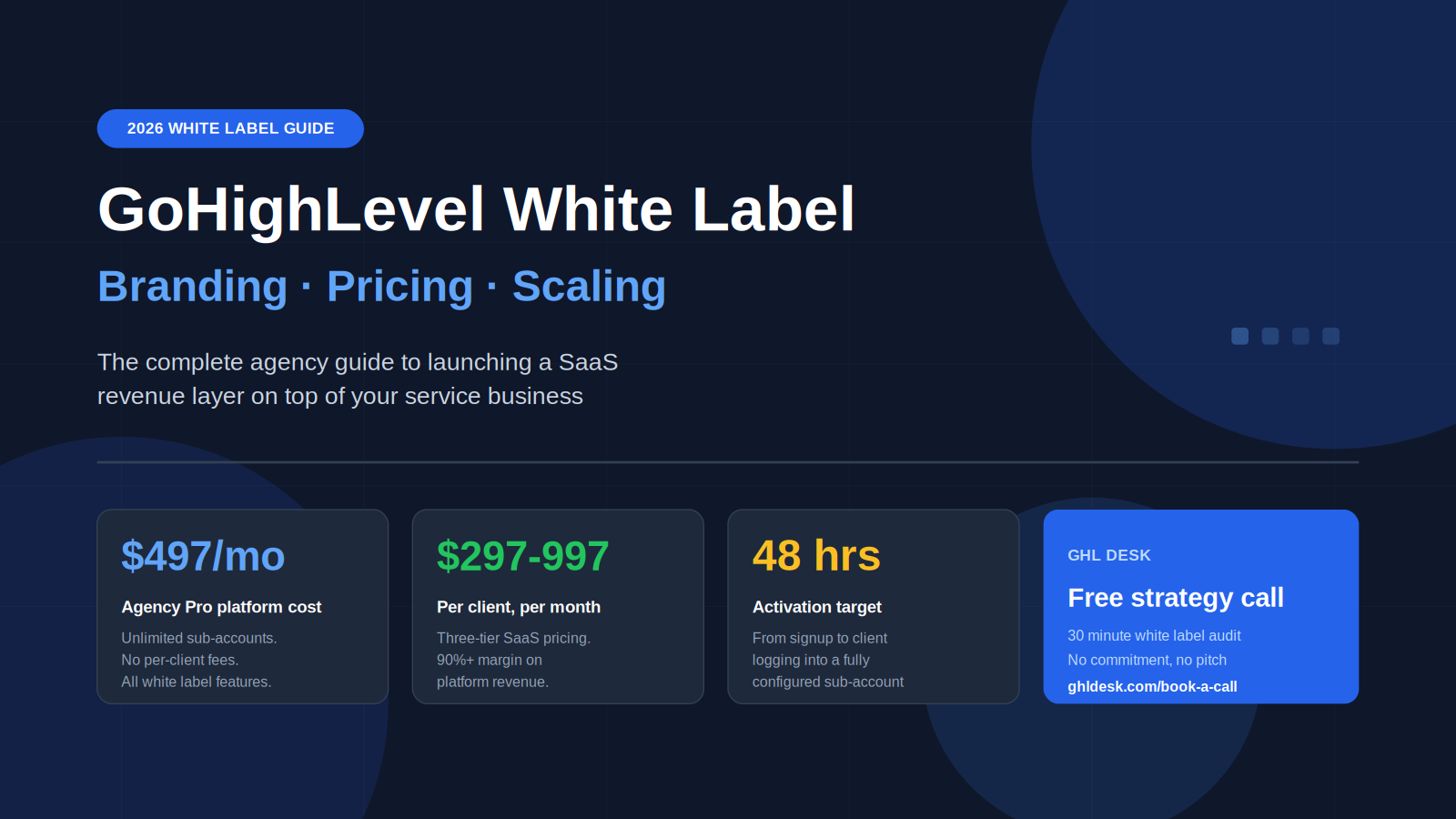
A GoHighLevel white label agency rebrands the platform as its own software product. Clients log in to your domain, see your logo, and pay your prices. GoHighLevel stays invisible. Visual white-label branding starts on the Unlimited plan at $297/month, and full SaaS Mode with automated client billing requires the Agency Pro plan at $497/month. Most agencies charge clients between $297 and $997 per month, which means breakeven sits at 2 to 3 clients. The real challenge is not the setup or the pricing. It is the operational reality of running a software product: client support, onboarding, churn management, and the fulfillment infrastructure that sits behind the brand. GHL Desk handles white-label fulfillment, support, and snapshot deployment for agencies running SaaS mode, with 48-hour onboarding so the agency owner runs the brand without running the operations.
If you are running a GoHighLevel agency in 2026 and not white-labeling the platform, you are leaving the highest-margin part of the business on the table. A services-only agency caps at the owner’s time. A white-label SaaS agency caps at infrastructure. The math is different, the model is different, and the work behind the scenes is dramatically different.
Most articles about GoHighLevel white label focus on the visible setup: which plan to buy, what to charge, how to upload your logo. Those articles miss the operational reality that decides whether the white-label agency actually works. What follows is the complete playbook covering the branding, pricing, technical setup, fulfillment infrastructure, support load, and scaling decisions that separate agencies that grow to 50 clients from agencies that quit at 8.
What GoHighLevel White Label Actually Means in 2026
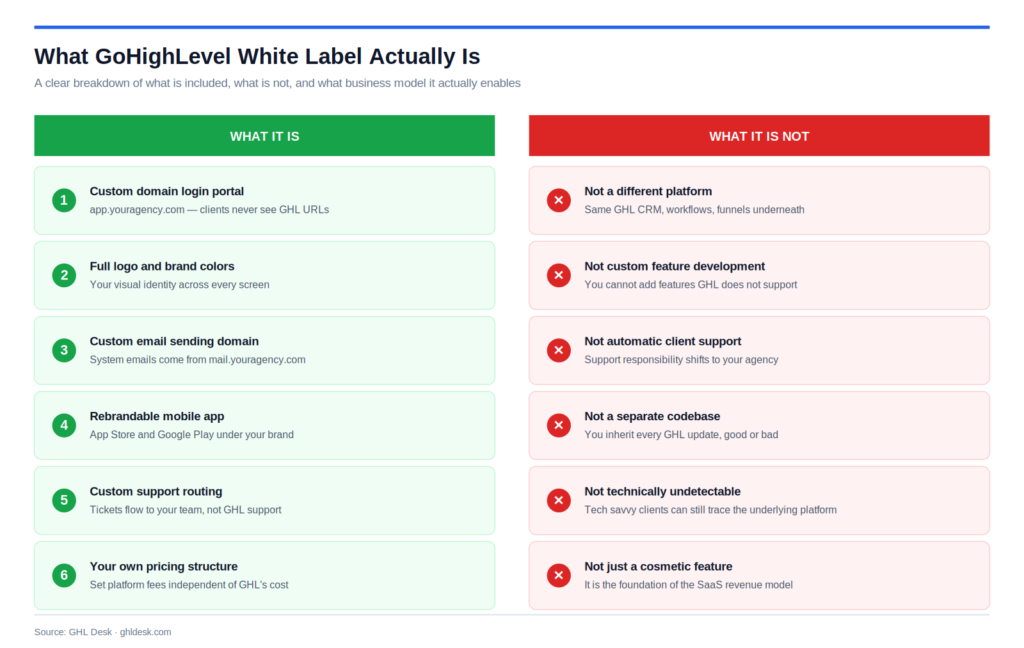
GoHighLevel white label is the platform feature that lets agencies remove every visible reference to GoHighLevel and replace it with their own branding. Your clients log in through your domain. They see your logo, your colors, your company name. They never encounter the GoHighLevel brand inside the interface, the emails, the SMS confirmations, or the mobile app if you have configured the white-label mobile app add-on.
This is structurally different from being a GoHighLevel affiliate or reseller. As an affiliate, you direct clients to GoHighLevel’s signup page and earn a commission. The relationship is between your client and GoHighLevel. As a white-label agency, the relationship is between your client and you. You set the pricing, you handle billing, you own the support relationship, you control the experience. GoHighLevel is your infrastructure provider, not your business partner from the client’s perspective.
The white-label model converts the agency from a services business into a software business. A services business sells time. A software business sells access to a product. The unit economics are different, the scaling math is different, and the ceiling is different. A services-only agency caps at roughly 25 to 40 clients because each client needs ongoing human attention. A white-label SaaS agency can scale past 200 clients because each new client adds margin without adding linear labor cost.
The trade-off is the operational depth required to run a software business well. Building the platform branding takes 1 to 3 days. Running the platform as a real product takes ongoing infrastructure that most agencies underestimate by a factor of 3 to 5. The agencies that white-label well are the ones that build the back-end operations before scaling the client base, not after.
The 3 Levels of White Label: From Visual to Full SaaS
Not all white-label setups are the same. GoHighLevel offers 3 distinct levels of white-label, each with different capabilities and different operational implications.
Level 1: Visual branding. Available on the Unlimited plan at $297/month. The platform interface shows your logo, your colors, and your custom domain. Clients access the platform through your subdomain (such as app.youragency.com) and see your brand throughout the dashboard. However, billing happens externally. You invoice clients through Stripe, manual invoices, or another billing system. You also manually create each new sub-account, configure it, and hand off access. This level works for agencies serving 5 to 15 clients who want the branded experience without committing to full SaaS infrastructure.
Level 2: Full SaaS Mode. Available on the Agency Pro plan at $497/month. Everything from Level 1 plus automated client provisioning, integrated billing through Stripe, customizable pricing tiers, and a branded signup page where clients can subscribe without agency intervention. This is the level that turns the agency into a real software business. New clients sign up, pay automatically, get their sub-account provisioned automatically, and start using the platform without anyone from your team manually onboarding them. The platform runs in the background while you focus on acquisition and retention.
Level 3: Branded mobile app. A $497/month add-on on top of either plan. Your agency gets its own iOS and Android app published in the Apple App Store and Google Play Store under your brand name. Clients download your app instead of the LeadConnector app. This level matters most for agencies serving industries where mobile usage is heavy (real estate agents, field service businesses, gym owners, consultants who run client communications from their phones). For agencies serving desktop-heavy clients, the branded mobile app rarely justifies the cost in the first 12 to 18 months.
Most agencies skip Level 3 until they have 20 or more active clients, then add it as a retention tool once the revenue justifies the monthly cost. The path from zero to scale typically runs Level 1 for the first 3 to 6 months while testing the model, then Level 2 once revenue stabilizes, then Level 3 when retention becomes a strategic priority.
Plan Comparison: Starter vs Unlimited vs Agency Pro
The plan you choose decides which white-label capabilities you can offer. The choice matters because the wrong plan creates ceilings the agency hits within 60 to 90 days of launch.
Starter Plan ($97/month). Single business account. Limited to 2 sub-accounts. No white-label features. This plan exists for individual business owners using GoHighLevel for their own operations, not for agencies serving clients. If white-label is the goal, the Starter plan is the wrong starting point. Agencies that start here and try to expand quickly discover they cannot grow past 2 clients without upgrading.
Unlimited Plan ($297/month). Unlimited sub-accounts. Visual white-label branding (Level 1). Custom domain support. No SaaS Mode, no automated billing, no pricing tier control. This plan works for agencies serving up to roughly 15 clients with manual billing and onboarding. The ceiling is operational, not technical: managing 15 clients with manual provisioning and invoicing is sustainable. Beyond that, the manual overhead becomes a full-time job by itself.
Agency Pro Plan ($497/month). Everything in Unlimited plus full SaaS Mode (Level 2). Automated client provisioning. Stripe billing integration. Customizable pricing tiers. Branded signup pages. This is the plan that turns the agency into a software business. The price difference between Unlimited and Agency Pro is $200/month, which gets recovered by adding a single client at $200/month or any client at any price above what Unlimited would have allowed.
Branded mobile app add-on ($497/month). Separate add-on layered on top of either Unlimited or Agency Pro. Includes Apple App Store and Google Play Store listings under your brand. The setup process takes 4 to 8 weeks for store approval. Once approved, your clients download your app instead of LeadConnector.
HIPAA compliance add-on (separate pricing). Required for agencies serving healthcare-adjacent industries (medical spas, dental practices, chiropractors, mental health providers). Includes a Business Associate Agreement (BAA) with GoHighLevel and HIPAA-compliant data handling configuration. The add-on stays active only while the main subscription is active. If the main subscription lapses, the BAA expires automatically and the agency loses HIPAA coverage immediately.
Annual billing. All plans offer annual billing at roughly 17 percent discount over monthly. For Agency Pro, the annual saving is approximately $1,000 per year. Annual billing also locks in the current pricing in the event of mid-year price increases, which GoHighLevel has done twice in the last 24 months.
The path most agencies follow: start on Unlimited at $297/month while validating the offer and onboarding the first 3 to 5 clients manually, then upgrade to Agency Pro at $497/month once SaaS Mode infrastructure becomes the bottleneck.
The Complete White Label Setup Sequence
The technical setup takes 1 to 3 days for an experienced operator and 5 to 7 days for someone new to the platform. The sequence below covers everything from initial plan upgrade to first client login.
Step 1: Upgrade to the right plan. From the agency dashboard, navigate to Subscription and select either Unlimited or Agency Pro depending on which white-label level you need. Allow 5 to 10 minutes for the upgrade to propagate. White-label features unlock once the new plan is active.
Step 2: Configure agency branding. Inside Agency Settings, upload your agency logo (recommended size 280×60 pixels, transparent PNG). Set your brand color scheme. Configure your favicon. Add your company name as it should appear throughout the platform. These changes apply across every client sub-account immediately.
Step 3: Set up your custom domain. Inside Agency Settings, navigate to Company. Add your custom domain or subdomain (typical setup uses app.youragency.com or platform.youragency.com). Update DNS records at your domain registrar: add a CNAME record pointing your subdomain to GoHighLevel’s servers. DNS propagation takes 10 minutes to 24 hours. SSL provisioning happens automatically once DNS resolves.
Step 4: Configure agency support contact. Set your agency support email and support phone number. This is what clients see when they need help, not GoHighLevel’s contact information. Make sure the email is monitored, because client support requests flow through this address from day one.
Step 5: Set up email deliverability infrastructure. Configure DMARC, DKIM, and SPF records on your sending domain. Without proper email authentication, client emails sent from the platform land in spam. This is one of the most commonly skipped steps and one of the highest causes of client complaints in the first 30 days post-launch.
Step 6: Complete A2P 10DLC registration. If serving US clients with SMS workflows, register your brand and campaigns through the A2P 10DLC compliance process. The registration takes 1 to 5 business days. Without A2P approval, SMS workflows fail silently across every client sub-account. Start this step early, not last.
Step 7: Build your base client snapshot. Create a sub-account that represents your standard client setup, including pipeline structure, custom fields, tag taxonomy, core workflows, funnels, calendars, and email templates. Save this as a master snapshot, which then auto-deploys to every new client sub-account.
Step 8: Configure SaaS Mode pricing tiers (Agency Pro only). Inside the SaaS Configurator, define your pricing plans. Set plan names, monthly prices, trial period length, and feature access per tier. Most agencies offer 2 to 3 tiers: a basic plan, a standard plan, and a premium plan. Each tier maps to different feature limits, included credits, and support levels.
Step 9: Build your SaaS signup page (Agency Pro only). The branded page where clients subscribe to your platform. GoHighLevel auto-generates a basic signup page, but most agencies build a custom landing page that better explains the offer. The signup page connects to Stripe for payment and auto-provisions a sub-account upon successful payment.
Step 10: Test the entire flow end-to-end. Sign up as a test user. Complete the payment flow with a real test card. Verify the sub-account provisions automatically. Verify the welcome email arrives. Verify the snapshot deploys correctly into the new sub-account. Verify the client can log in and access the platform without intervention. This 30-minute test catches the production issues that would otherwise surface during the first real client signup.
A setup completed through these 10 steps produces a white-label agency ready to onboard clients without operational drama. A setup that skips steps creates problems that compound across every client added afterward.
Pricing Your White Label Platform (And Why Most Agencies Get It Wrong)
Pricing is the decision that decides agency profitability more than any other variable. Most agencies underprice at launch and spend years trying to recover.
The pricing principle that matters. Your platform price should reflect the value clients receive, not the cost you pay GoHighLevel. A client running their entire CRM, email marketing, SMS marketing, calendar, funnels, and automation through your platform receives software value that compares against $300 to $500 per month of equivalent point solutions (Calendly + Mailchimp + HubSpot Starter + a basic SMS tool + funnel builder = $300 to $500/month minimum). Pricing your platform below that range tells the client your software is worth less than the tools it replaces.
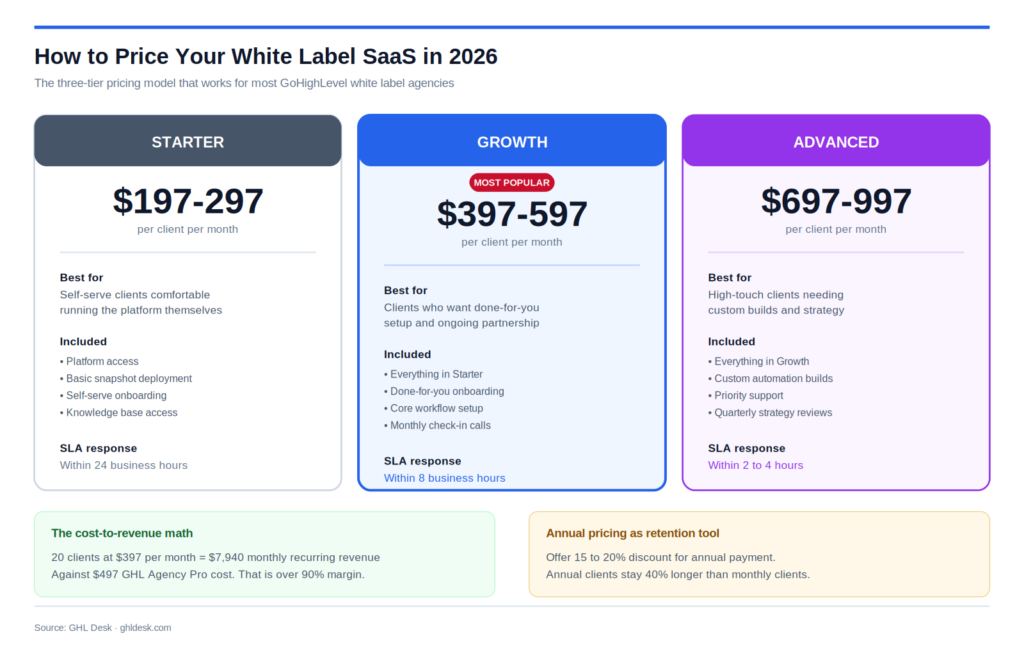
The price range that works in 2026. Most successful white-label agencies charge between $297 and $997 per month, with the sweet spot for local businesses sitting at $397 to $597 per month. Pricing below $297 attracts price-sensitive clients who churn quickly and consume disproportionate support. Pricing above $997 requires either a premium niche (legal, medical, financial services) or a significantly differentiated service layer on top of the software.
Three-tier pricing structure. Most agencies offer 3 tiers: a starter tier (limited features, basic support), a standard tier (full features, business-hours support), and a premium tier (full features, priority support, included done-with-you services). Three tiers let clients self-select based on their needs and produce a higher average revenue per client than single-tier pricing.
The launch pricing mistake. Agencies that start at $97 or $147 per month find it nearly impossible to raise prices later. The price anchor sets in fast. Clients who signed up at $97 resist a move to $297, even if the value clearly justifies it. The pattern is to launch at the price you want to sustain, not the price you think will be easy to sell. $297/month minimum for the entry tier protects the agency from the low-price trap.
Annual billing discount. Offer a 15 to 20 percent discount for annual prepayment. This locks in the client for 12 months, reduces churn, and improves cash flow. Most agencies see 30 to 50 percent of clients opt for annual billing when the discount is offered correctly.
Setup fees. Most agencies charge a one-time setup fee of $497 to $1,997 in addition to the monthly platform fee. The setup fee covers onboarding, training, customization, and any done-for-you services included in the initial deployment. Setup fees filter out tire-kickers and produce immediate revenue rather than waiting 6 to 12 months of monthly billing to break even.
Markup on usage-based features. SMS messages, email sends, AI credits, and phone minutes can be rebilled to clients at a markup. Most agencies mark up usage by 50 to 100 percent. A $0.0075 SMS cost gets rebilled to clients at $0.015. Across 50 clients, usage markup produces meaningful margin (typically $500 to $3,000 per month) without any additional sales work.
Breakeven math at common prices. At $297/month per client, Agency Pro breaks even at 2 clients. At $497/month per client, breakeven is at 1 client. At $997/month per client, breakeven sits below 1 client. The plan cost is the smallest variable in agency profitability. Pricing and retention drive the actual outcome.
The Operational Reality Nobody Tells You About
This is the section every white-label guide skips, and it is the section that decides whether the agency survives the first 12 months. Running a white-label platform is operationally heavier than running a services agency, and the support load alone breaks most agencies that scale too fast.
Client onboarding is the first hidden cost. Every new client signing up to your white-label platform needs onboarding even if SaaS Mode auto-provisions the sub-account. The client needs help connecting their phone number, configuring their calendar, importing contacts, setting up integrations, and learning the platform basics. A proper onboarding takes 2 to 4 hours of agency time per client, spread across the first 14 to 30 days. Without structured onboarding, churn in month 1 climbs to 25 to 40 percent.
Support volume scales sub-linearly but not zero. Each client generates support requests at a predictable rate: roughly 2 to 5 support tickets per month for active clients, climbing to 8 to 12 tickets per month for clients in their first 90 days. At 20 clients, that produces 40 to 100 support tickets per month. At 50 clients, 100 to 250 tickets per month. Without dedicated support infrastructure, the agency owner ends up doing support full-time and stops doing anything else.
Platform updates require client communication. GoHighLevel ships platform updates regularly. Some updates change features, some break workflows, some require client configuration changes. Every meaningful update requires the agency to communicate the change to clients, often with documentation or training updates. The communication overhead alone takes 4 to 8 hours per month for an active agency.
Churn management is operational, not just a metric. Healthy white-label agencies see 3 to 8 percent monthly churn in the first year, stabilizing to 2 to 4 percent monthly after year 2. At 50 clients with 5 percent monthly churn, the agency loses 2 to 3 clients per month, or roughly 30 clients per year. Replacing those clients requires consistent acquisition. The agencies that focus only on acquisition without addressing churn run on a treadmill.
Snapshot maintenance scales with client count. The master snapshot that deployed at client acquisition needs ongoing maintenance. Workflow improvements, messaging refreshes, compliance updates, and version control across active sub-accounts. At 50 clients, snapshot maintenance alone consumes 15 to 25 hours per month of focused operational work.
The 25-client wall. Most white-label agencies hit a ceiling around 25 active clients. This is the point where the founder’s personal capacity gets fully consumed by onboarding, support, and operations, leaving no time for acquisition. Breaking through 25 clients requires either hiring an operations team (which most founders are unprepared for) or outsourcing the fulfillment infrastructure to a specialist. Agencies that try to push through with the same one-person operation usually grind to a halt at 30 to 35 clients and then start losing more than they gain.
This is the operational reality that pricing tables and feature comparisons never show. White-label agencies that thrive long-term build the back-end infrastructure first, then scale the front-end acquisition. White-label agencies that scale acquisition first and figure out operations later usually do not make it past month 18.
SaaS Mode: How Client Billing and Provisioning Actually Work
SaaS Mode is the feature that converts the white-label setup from a manual operation into an automated software product. Understanding what it actually does (and what it does not do) matters before committing to the Agency Pro plan.
Automated sub-account provisioning. When a client completes payment on your signup page, GoHighLevel automatically creates a new sub-account, applies the snapshot you designated as default, and sends the client a welcome email with login credentials. This entire flow runs without agency intervention, which is the core operational lift SaaS Mode provides.
Stripe integration for recurring billing. SaaS Mode connects to your Stripe account and handles recurring monthly or annual billing automatically. Failed payments trigger automated retry sequences. Cancellations can be processed through the client’s account or through your admin panel. The billing infrastructure is production-ready out of the box, which saves the agency from building it separately.
Pricing tier control. The SaaS Configurator lets you define multiple pricing tiers with different feature access, included credits (SMS, email, AI), and trial periods. Clients see the tiers on your signup page and self-select based on their needs. Tier changes can be applied to existing clients with automatic prorating.
Rebilling for usage-based features. SaaS Mode automatically tracks SMS, email, AI, and phone minute usage per sub-account and bills clients at the markup you configure. Markup is set as a percentage above GoHighLevel’s wholesale cost. Most agencies set markups between 50 and 100 percent. The rebilling happens automatically through the same Stripe integration as the base subscription.
What SaaS Mode does not handle. Onboarding is not automated beyond the welcome email. Support tickets do not get routed automatically. Custom workflow requests still require human intervention. Integration setup (Stripe for the client’s payment processing, Twilio for their phone numbers, Mailgun for their email) is not automated. Every new client still requires meaningful human time even with full SaaS Mode active.
The branded signup page. SaaS Mode includes a default signup page, but most agencies build a custom landing page that better explains the offer. The custom page captures payment information, then redirects to GoHighLevel’s checkout for the actual subscription creation. The conversion rate on the default signup page is significantly lower than on a custom-built landing page in most cases.
Trial period configuration. Each pricing tier can offer a free trial period of 7, 14, or 30 days. Trials typically convert at 20 to 40 percent depending on the onboarding quality. Agencies that ship a “self-serve trial” without onboarding intervention usually see conversion below 15 percent. Agencies that include a kickoff call during the trial period see conversion climb to 35 to 50 percent.
Cancellation handling. When a client cancels, the sub-account remains accessible for the duration of the paid period. After expiry, the sub-account moves to inactive status. Data is retained for a grace period (typically 30 days) and then archived. Clients can reactivate within the grace period without data loss.
SaaS Mode reduces the operational lift of running a white-label platform by roughly 40 to 60 percent compared to manual Unlimited-plan management. It does not eliminate the operational lift entirely, and agencies that expect it to are usually disappointed.
The Support Load That Breaks Most White Label Agencies
Support is the operational layer that most white-label agencies underestimate by the largest margin. Understanding the actual support volume and structure before launch prevents the most common scaling failure.
Support ticket volume per client. An active client in months 2 through 12 generates 2 to 5 support tickets per month. A new client in their first 90 days generates 8 to 12 tickets per month as they learn the platform. The ratio settles after the first quarter, but the front-loaded volume drives the operational profile.
Common ticket categories. Login issues (clients forgetting passwords or struggling with 2FA setup). Email deliverability problems. SMS workflow failures. Integration setup confusion (Stripe, Twilio, Google Calendar). Workflow logic questions. Reporting questions. Feature requests that are not actually possible inside GHL. Roughly 60 percent of tickets fall into 5 to 7 recurring categories that can be addressed through documentation and templates.
Response time expectations. Most agencies promise some version of “business hours response within 4 hours” in their service level agreement. Meeting this consistently requires either a dedicated support team or specialized tooling (helpdesk software, response templates, knowledge base). Agencies that promise faster response times (1 hour, same-day) without the infrastructure to deliver usually fail their own SLA within 60 days.
The response template library. Mature white-label agencies maintain a library of 30 to 60 response templates covering the most common ticket categories. New tickets get categorized, the appropriate template gets applied with minor customization, and the response goes out in 5 to 10 minutes instead of 20 to 30. This template discipline is the difference between a sustainable support operation and an unsustainable one.
Tier 1 vs Tier 2 vs Tier 3 support. Tier 1 is the routine 60 percent of tickets handled with templates. Tier 2 is the 30 percent requiring real diagnostic work (broken workflows, integration failures, configuration issues). Tier 3 is the 10 percent requiring escalation to GHL support or deep technical investigation. The agencies that scale build clear escalation paths between tiers and assign different team members to each level.
The cost of solo founder support. A founder handling all support for 25 clients spends roughly 20 to 30 hours per week on tickets. This consumes the time that should go into sales, partnerships, and strategic improvements. The founder ends up doing the lowest-leverage work in the agency, which is usually the worst possible allocation of founder time.
The white-label support partnership option. Several specialist firms offer white-labeled support for GHL agencies, where the support team operates under the agency’s brand without the agency hiring or managing them directly. GHL Desk’s support layer handles tickets, integrations, snapshot maintenance, and ongoing fulfillment as a back-office function, leaving the agency owner free to focus on acquisition and strategy.
Support cost per client. Most agencies underestimate this by 3x to 5x. Realistic support cost per active client in a mature operation is $40 to $120 per month, depending on the niche and the client profile. For an agency charging $497/month per client, support consumes 8 to 24 percent of the monthly revenue. This is the cost line that determines whether the agency is actually profitable or just appearing profitable on top-line revenue.
Who Should White Label and Who Should Wait
The white-label model works for some agency profiles and fails for others. The honest assessment matters more than the upside framing most marketing content puts forward.
Who should white label. Agencies with at least 5 active service clients who already use GoHighLevel and could benefit from a productized platform offering. Agencies serving a specific niche where the same workflows, snapshots, and templates apply across most clients. Agencies with at least one team member (founder included) who can dedicate 15 to 25 hours per week to platform operations. Agencies with operational discipline around documentation, processes, and support response.
Who should wait. Agencies in their first 12 months without a clear niche. Agencies with fewer than 3 services clients on GoHighLevel. Agencies where the founder is the only person involved in fulfillment. Agencies without basic operational infrastructure (helpdesk, knowledge base, response templates). Agencies that have not yet built a reliable client onboarding system for their existing service clients.
The hybrid model that often works better. Many agencies thrive with a hybrid model: services as the primary revenue, white-label platform access as an upsell or retention layer. The platform produces recurring revenue from existing service clients without the agency taking on full SaaS Mode operations. This model lets the agency add white-label revenue without absorbing the full operational lift of running a pure SaaS business.
The signal you are ready. You have at least 5 GoHighLevel service clients who pay you monthly. You have a clear niche or 2 niches where most of your clients fit. You have at least one master snapshot that deploys consistently across clients. You have documented your support response process. You have 15 to 25 hours per week available for platform operations, either in your own time or through team members. If all 5 signals are true, white-labeling is likely a good next step. If 3 or fewer are true, building those foundations first usually produces better long-term outcomes than rushing into SaaS Mode.
The signal to skip white-labeling entirely. If your agency is fundamentally a services business and you do not want to operate a software product, white-labeling is the wrong direction. Services agencies can use GoHighLevel without white-labeling, billing clients separately for services and platform access. This model has lower margins than full white-label but also lower operational complexity. Some of the highest-revenue agencies on GoHighLevel deliberately avoid white-label because the services model fits their team and personality better.
The right answer depends on your stage, your team, your niche, and your appetite for software-business operations. The wrong answer is launching white-label because everyone says it is the path to higher revenue. The path matters more than the destination.
How GHL Desk Runs White Label Fulfillment for Agencies
For agency owners running white-label SaaS or planning to launch, GHL Desk operates as the fulfillment infrastructure that sits behind your brand. Your clients never see us. They see your platform. Onboarding for qualifying agencies is 48 hours, not weeks.
Every engagement starts with a free strategy call, a 30-minute conversation that audits your current white-label situation, identifies the niche and pricing structure that fits your agency, and maps the fulfillment infrastructure you actually need. If we are not the right fit, we tell you that directly.
For qualifying agencies, we build the complete white-label fulfillment stack: master snapshot library across your niches, client onboarding sequences, support response templates, helpdesk configuration, integration setup, and the operational documentation that lets your platform scale past the founder’s personal capacity. The entire setup happens under your brand. Clients only ever see your name, your logo, your support address.
For agencies running SaaS Mode at scale, we handle ongoing operations: client onboarding calls, support ticket response, snapshot maintenance, workflow updates, integration troubleshooting, and the monthly maintenance load that breaks most solo agency operations. The work runs continuously without the agency owner managing any of it.
For agencies serving healthcare-adjacent niches, we handle HIPAA-compliant fulfillment under the agency’s BAA. For agencies running hybrid workflows beyond native GHL, our integration team handles the N8N or custom API layer. For agencies running full client portfolios, our team scales with the agency rather than adding linear cost per client.
Pricing starts at $150 for a 5-hour pay-as-you-go block for agencies testing the partnership, $997 per month for a shared team handling ongoing white-label operations, and $2,497 per month for a dedicated team running full fulfillment across unlimited sub-accounts. Every plan is white-label by default. Your clients only ever see your brand.
If your agency is stuck at the 25-client wall, or planning to launch white-label and wants the operational infrastructure ready before client one, book a free strategy call and we will map exactly what your fulfillment stack should look like.
.gd-faq{font-family:inherit;max-width:780px;margin:2rem auto} .gd-faq-h{font-size:26px;font-weight:700;color:#111;margin:0 0 1.25rem;padding-bottom:0.75rem;border-bottom:2px solid #2563eb} .gd-item{border:1px solid #e5e7eb;border-radius:10px;margin-bottom:8px;overflow:hidden} .gd-btn{width:100%;background:#fff;border:none;padding:16px 20px;display:flex;justify-content:space-between;align-items:center;cursor:pointer;text-align:left;gap:1rem} .gd-btn:hover{background:#f9fafb} .gd-qt{font-size:15px;font-weight:600;color:#111;line-height:1.4;font-family:inherit} .gd-ic{width:26px;height:26px;border-radius:50%;background:#f3f4f6;border:1px solid #d1d5db;display:flex;align-items:center;justify-content:center;flex-shrink:0;transition:all 0.2s} .gd-ic svg{transition:transform 0.25s ease} .gd-item.open .gd-ic{background:#dbeafe;border-color:#93c5fd} .gd-item.open .gd-ic svg{transform:rotate(45deg)} .gd-body{max-height:0;overflow:hidden;transition:max-height 0.3s ease} .gd-inner{padding:0 20px 16px;border-top:1px solid #f3f4f6} .gd-inner p{font-size:14.5px;color:#4b5563;line-height:1.8;margin:12px 0 0;font-family:inherit} .gd-inner strong{color:#111;font-weight:700} .gd-item.open .gd-body{max-height:600px}Frequently Asked Questions
GoHighLevel white label is the platform feature that lets agencies remove every visible reference to GoHighLevel and replace it with their own branding. Clients log in through your domain, see your logo, and pay your prices. GoHighLevel becomes invisible. The agency operates as a software business selling access to a branded CRM platform, with GoHighLevel as the back-end infrastructure provider.
Visual white-label branding (logo, colors, custom domain) requires the Unlimited plan at $297/month. Full SaaS Mode with automated client billing, pricing tiers, and auto-provisioning requires the Agency Pro plan at $497/month. The branded mobile app is a separate $497/month add-on. The Starter plan at $97/month does not include white-label features and is the wrong choice for agency use.
Most successful white-label agencies charge between $297 and $997 per month, with the sweet spot for local businesses at $397 to $597 per month. Pricing below $297 attracts price-sensitive clients with high churn and disproportionate support load. Pricing above $997 requires a premium niche or significant service layer on top. Add a one-time setup fee of $497 to $1,997 to filter out tire-kickers and produce immediate revenue.
The technical setup takes 1 to 3 days for an experienced operator and 5 to 7 days for someone new to the platform. This covers plan upgrade, branding configuration, custom domain setup, email deliverability infrastructure, A2P 10DLC registration, master snapshot creation, SaaS Mode pricing tiers, and end-to-end testing. Building the back-end fulfillment infrastructure (support templates, onboarding sequences, documentation) takes another 2 to 4 weeks beyond the technical setup.
On the Agency Pro plan with white label properly configured, no. Clients log in through your domain, see your logo, interact with your brand name throughout the interface, and receive emails and SMS from your sender addresses. GoHighLevel does not appear in the interface, email headers, support pages, or mobile app if you have the branded mobile app add-on. The exception is the LeadConnector mobile app, which retains LeadConnector branding unless you upgrade to the branded mobile app add-on at $497/month.
You can run visual white-label without SaaS Mode on the Unlimited plan at $297/month, but you handle client billing, sub-account creation, and onboarding manually. This works for agencies serving up to 15 clients. Beyond that, manual operations consume too much time. SaaS Mode (Agency Pro plan) automates billing, provisioning, and pricing tier management, which is what unlocks growth past the 15-client ceiling.
At $497/month for Agency Pro and a client price of $297/month, breakeven is at 2 clients. At a client price of $497/month, breakeven is at 1 client. The plan cost is the smallest variable in agency profitability. The real costs that determine profit are support time, onboarding hours, churn, and the operational infrastructure required to run the platform sustainably.
An active client in months 2 through 12 generates 2 to 5 support tickets per month. New clients in their first 90 days generate 8 to 12 tickets per month. At 25 active clients, this produces 50 to 200 tickets monthly. Most agencies underestimate this volume by 3 to 5x at launch. Realistic support cost per active client is $40 to $120 per month in a mature operation, which is 8 to 24 percent of a typical $497/month client subscription.
Yes, through the branded mobile app add-on at $497/month on top of either Unlimited or Agency Pro. Your agency gets its own iOS and Android app published in the Apple App Store and Google Play Store under your brand. Setup and store approval take 4 to 8 weeks. Most agencies skip this until they have 20 or more active clients, then add it as a retention tool when the recurring revenue justifies the monthly cost.
White label is the visual branding (logo, colors, domain) that makes the platform look like your agency’s product. SaaS Mode is the operational layer (automated client billing, auto-provisioning, pricing tier control, branded signup page) that turns the white-labeled platform into a self-serve software product. White label can run without SaaS Mode on the Unlimited plan. SaaS Mode requires the Agency Pro plan. Most agencies that scale past 15 clients eventually need both.
The niches that work best in 2026 are local service businesses (home services, dental, chiropractic, fitness, med spas, real estate) where the same workflows apply across most clients in the niche. Industries with strong communication needs (HVAC, plumbing, roofing) work well because of GHL’s call tracking and SMS infrastructure. Healthcare-adjacent niches require the HIPAA compliance add-on. The wrong fit is highly bespoke industries where every client needs custom workflows from scratch, which defeats the point of a productized platform.
The signal to outsource is the 25-client wall: the point where the founder’s personal capacity gets fully consumed by onboarding, support, and operations, leaving no time for acquisition. Agencies that try to push past 25 clients alone usually stall at 30 to 35 and start losing more than they gain. Outsourcing the back-end fulfillment to a specialist white-label partner lets the agency scale past the founder’s capacity while keeping the brand and client relationship in-house. GHL Desk’s free strategy call identifies within 30 minutes whether outsourcing fits your stage.