⚡ Quick Answer
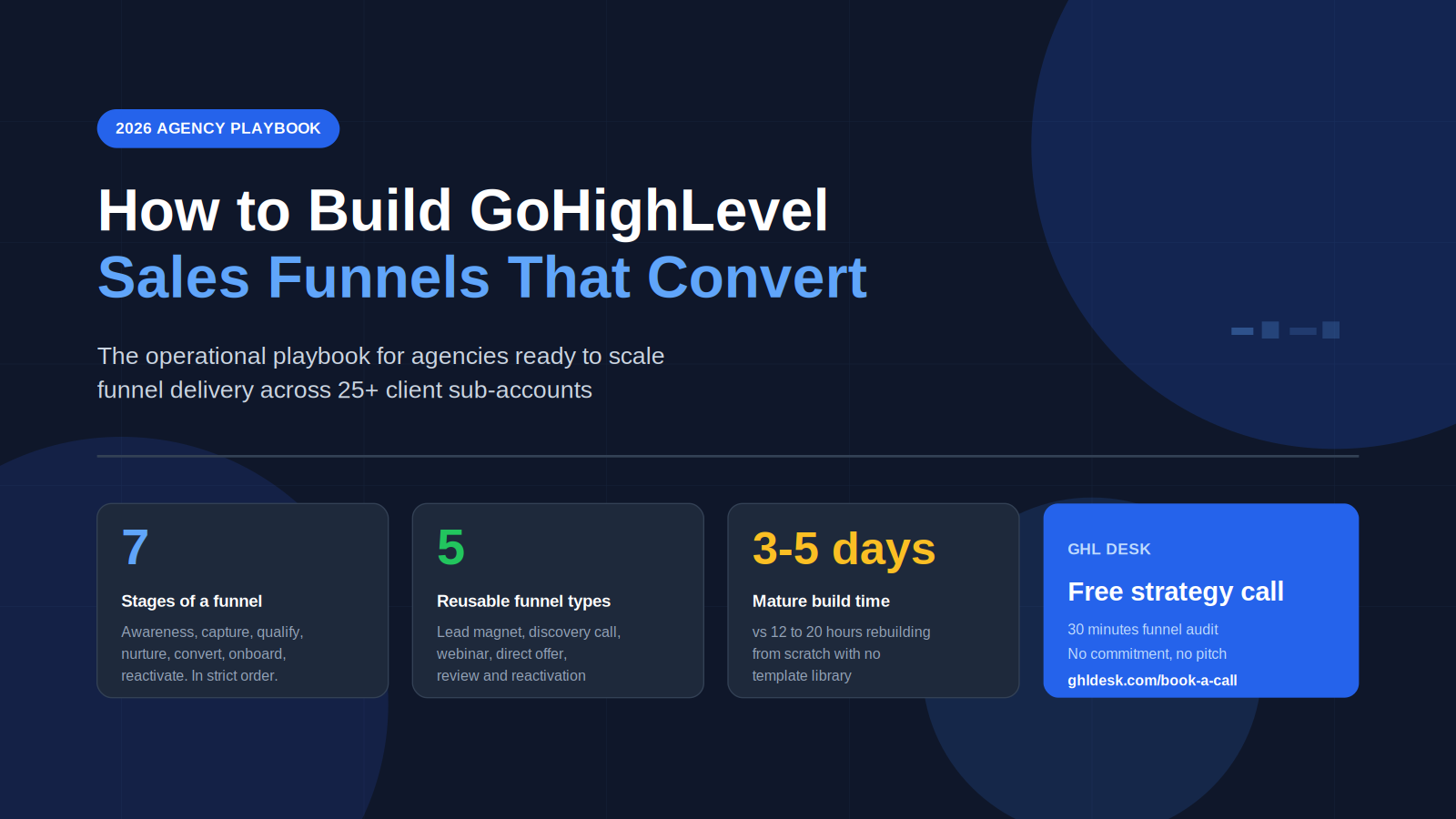
Building a GoHighLevel sales funnel that actually converts is not a drag-and-drop exercise. It is a 7-stage process that starts with a documented buyer journey, runs through page architecture, copy, integrations, and automation, and ends with conversion tracking that ties revenue back to the funnel. Agencies that build one funnel at a time hit a ceiling fast. The agencies that scale build reusable funnel templates inside niche snapshots, deploy them across client sub-accounts in under 30 minutes, and refresh messaging on a quarterly cycle. A correctly built funnel takes 3 to 5 business days from intake to launch when the system is mature. GHL Desk builds, deploys, and maintains funnels across agency sub-accounts in 48-hour onboarding, so agency owners stop rebuilding the same lead capture pages for every new client.
If you are running a GoHighLevel agency in 2026 and still building every client funnel from a blank page, you are doing the most expensive version of the work. Every funnel you ship costs 8 to 16 hours of labor that a mature template library would do in 3. Multiply that by 15 clients and you are losing a full work week every month to rework that should not exist.
Most articles about building GoHighLevel funnels are written for beginners learning the drag-and-drop editor. This one is different. It is written for agency owners who already know how to build a page and want to know how to build funnels at scale, across multiple clients, with the operational discipline that separates 10-client agencies from 50-client agencies. What follows is the actual playbook for funnels that convert, deploy cleanly, and do not break in production.
What Makes a GoHighLevel Funnel Different From a Generic Landing Page
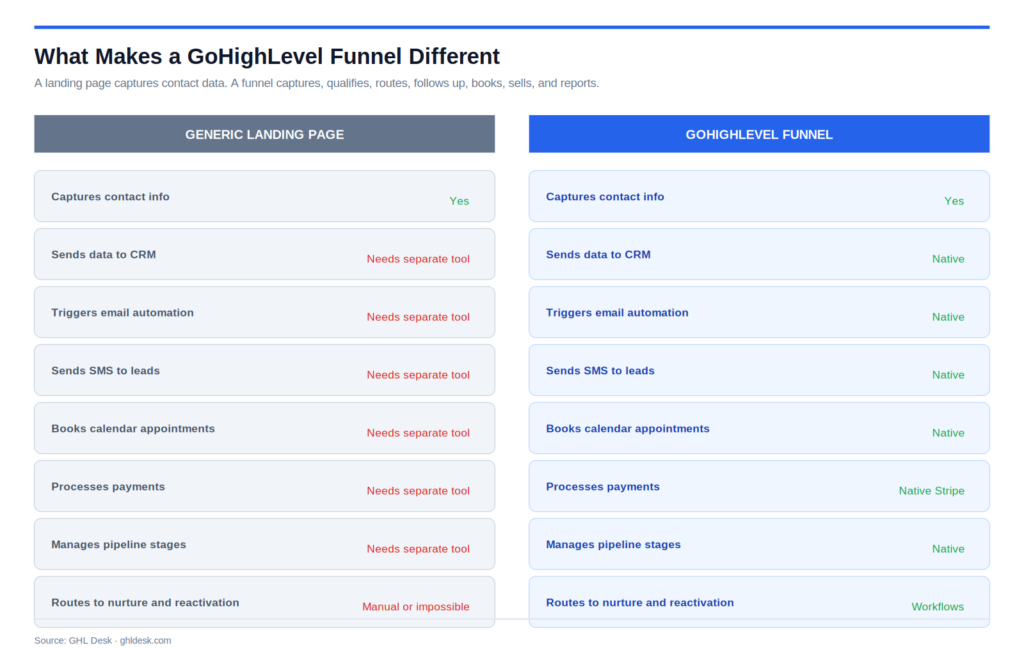
A GoHighLevel sales funnel is a connected sequence of pages, forms, automations, pipelines, and tracking that moves a stranger from first click to closed customer inside a single system. The difference between a funnel and a landing page is the connective tissue. A landing page captures contact information. A funnel captures, qualifies, routes, follows up, books, sells, and reports, all without leaving the platform.
Generic funnel builders like ClickFunnels, Leadpages, and Unbounce handle the page layer well and stop there. You still need a separate CRM, a separate email tool, a separate SMS platform, a separate calendar, a separate payment processor, and a separate analytics layer. Every integration adds a failure point and a recurring cost. GoHighLevel collapses the entire stack into one platform, which is the single biggest reason agencies migrate to it.
The trade-off is that GHL funnels require operational discipline. The funnel itself is only one component. Without the right pipeline configuration, custom fields, tag taxonomy, and automation triggers behind it, a beautifully designed funnel sits there capturing leads that go nowhere. The leads accumulate in the CRM, no workflow fires, no SMS goes out, and the agency spends weeks debugging why “the funnel isn’t working” when the funnel is actually fine. The problem is the missing infrastructure around it.
This is also why drag-and-drop tutorials miss the point. Building the page is the easy 20 percent of the job. The 80 percent that determines whether the funnel converts is the integration, automation, and tracking layer that sits underneath. The agencies that consistently ship high-converting funnels in 2026 spend most of their time on the invisible parts of the build.
The 7 Stages of a High-Converting Sales Funnel
Every funnel that converts well in 2026 moves through 7 stages, in order. Skipping a stage or rearranging them is the most common reason funnels underperform.
Stage 1: Awareness traffic. The funnel starts before the landing page loads. Paid ads, organic content, referral sources, or direct outreach drive the click. The funnel inherits the quality of the traffic it receives. A perfect page paired with bad traffic produces nothing. The traffic source must match the offer, the audience, and the intent level of the funnel.
Stage 2: Lead capture. The first on-page action. Name, email, phone in most cases. The friction here decides the top-of-funnel conversion rate. Every additional field cuts opt-in rate by 5 to 10 percent. The principle is to capture the minimum data needed to start a conversation, then enrich the contact through later stages.
Stage 3: Qualification. Not every lead is worth a sales conversation. A short qualification step, usually 2 to 3 questions, separates leads worth pursuing from leads worth deprioritizing. Qualification can happen on the page after opt-in, through an SMS sequence, or through a discovery form. Skipping this stage means the sales team burns time on leads that were never going to close.
Stage 4: Nurture. Not every qualified lead is ready to buy on day one. The nurture sequence keeps the lead warm across multiple channels. Email, SMS, sometimes voice drops. Usually 5 to 14 days for cold or low-intent funnels, often shorter for high-intent funnels. The multi-channel nurture sequence is one of the highest-leverage automation layers in any GHL agency.
Stage 5: Booking or buying. The conversion event. For service-based businesses, this is usually a booked appointment. For ecommerce or info products, it is a completed purchase. The page or sequence that produces this action carries the most weight in the entire funnel. Friction here costs revenue directly.
Stage 6: Onboarding. What happens after the conversion event. Welcome sequences, payment confirmations, expectation-setting, kickoff calls. Most agencies treat this as an afterthought. The agencies that build the strongest retention treat it as a core funnel stage, with documented messaging and automated handoffs.
Stage 7: Reactivation. Leads who did not convert do not disappear. A small percentage become buyers later if reached at the right moment. The reactivation layer sits at the end of the funnel and reaches back to cold leads through value-based outreach. This stage is invisible to most agencies and produces 5 to 15 percent of revenue for agencies that build it correctly.
A funnel that covers all 7 stages compounds. A funnel missing any one of them leaks leads at that exact point and never recovers them.
The Page Architecture Every Funnel Needs
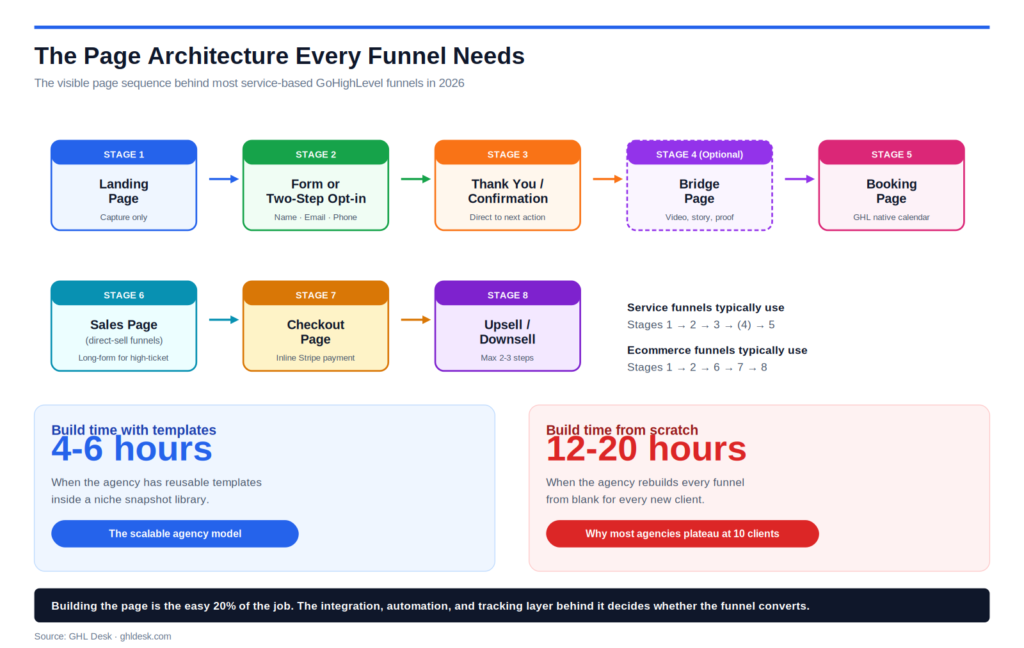
The visible part of the funnel is the page sequence. Most service-based funnels in 2026 use a variation of the following architecture, with adjustments for the specific offer.
Landing page. The first page the lead sees. The job of this page is one specific action: capture contact information. Strong landing pages share a few traits. A specific headline that names the audience and the outcome. A short subheadline that addresses the immediate objection. A single visible call to action above the fold. Social proof close to the form. No navigation menu. No external links. The page exists for one purpose, and every element either serves that purpose or gets removed.
Form or two-step opt-in. The conversion mechanism. Two-step opt-ins (click a button, then see the form) typically convert 10 to 30 percent higher than inline forms because the first click is a small commitment that increases the second action. Fields stay minimal. Name, email, phone. Adding company name, industry, or budget on the first form drops opt-in rate noticeably without improving qualification meaningfully.
Thank you or confirmation page. What loads immediately after the form submits. This page does more than acknowledge the opt-in. A well-built thank you page directs the lead to the next action: book a call, watch a video, check email, or take a qualifying micro-action. Sending leads to a blank “thanks” page wastes the highest-attention moment in the entire funnel.
Bridge page (optional). A page between the landing page and the offer page, usually containing a video, a story, or social proof. Bridge pages work well for higher-ticket offers where trust needs to build before the call to action. They are not necessary for low-friction lead capture and often hurt conversion when added unnecessarily.
Booking page. Where the qualified lead schedules a call. GoHighLevel calendars handle this natively. The configuration that matters: round-robin assignment if multiple team members handle calls, buffer time between appointments, confirmation messaging, reminder cadence, reschedule and cancellation links. A booking page without proper reminder automation leaks 30 to 50 percent of bookings to no-shows.
Sales page (for direct-sell funnels). Long-form for high-ticket offers, short-form for low-ticket. The structure that consistently works in 2026: problem statement, agitation, solution introduction, proof, offer details, FAQ, final call to action, scarcity if applicable. Most agencies overcomplicate sales pages with too many elements. The page exists to make one decision easy.
Checkout page. Where payment happens. Inline checkout converts better than redirect checkout. Two-step order forms (contact details, then payment) outperform single-step on most offers. Order bumps and one-time offers placed after the primary purchase increase average order value without hurting primary conversion.
Upsell and downsell sequence. Pages that load after the initial purchase, offering additional products. This is where average order value gets built. The discipline is to keep upsells relevant, easy, and limited. Two or three upsell steps maximum. Beyond that, conversion on the upsells themselves drops because attention fades.
A funnel built from this architecture, configured correctly, deploys in 4 to 6 hours when the agency has reusable templates. From scratch, it takes 12 to 20 hours. The difference is the template library.
How to Build the Funnel Inside GoHighLevel, Step by Step
The actual build sequence inside GHL matters because skipping steps creates problems that surface later in production. This is the order that produces clean funnels every time.
Step 1: Create the sub-account funnel structure. Inside the target sub-account, navigate to Sites, then Funnels, then New Funnel. Name the funnel using a strict convention such as Client-Offer-Version, for example Acme-LeadMagnet-v1. Build the empty funnel container first, before adding any pages. This forces clarity on what the funnel is and reduces the urge to start designing before strategy is locked.
Step 2: Configure custom fields and tags before building pages. Every form on the funnel needs to capture data into the right custom fields. Every tag the workflows depend on needs to exist before the funnel goes live. Skipping this step means rebuilding forms and reconfiguring workflows after the pages are already built, which doubles the work.
Step 3: Build the page sequence using a template. Most agencies do not build from blank in 2026. They use a base template, either from the GHL template library, from their internal snapshot, or from a purchased template pack. Replace placeholder copy with offer-specific copy. Replace placeholder images with niche-appropriate visuals. Adjust the page sequence to match the funnel architecture for this specific offer.
Step 4: Build the forms. GHL forms are built separately from pages, then dragged onto the page. Build the form with the exact fields needed for this stage of the funnel. Configure the form to apply the right tags on submission. Configure the form to add the contact to the right pipeline at the right stage. Configure the form to redirect to the correct next page after submission. The redirect target is set inside the form itself, not the page.
Step 5: Connect the booking calendar. If the funnel includes a booking step, the calendar must be configured separately and embedded onto the booking page. Calendar settings include availability windows, round-robin or single-user routing, buffer time, confirmation messaging, and reminder cadence. Confirm calendar appears correctly when the page is published, since calendars sometimes fail to load on first publish.
Step 6: Set up payment processing if applicable. Stripe connection happens at the sub-account level under Payments. Once connected, products get created inside the Products section. Each product is then added to a checkout page through the Order Form element. Tax settings, currency, and trial periods get configured on the product itself, not on the page.
Step 7: Build the workflows that trigger off the funnel. This is where most agencies stop too early. The funnel pages capture data, but the workflows are what turn the captured data into nurture, qualification, booking confirmation, and reactivation sequences. At minimum, every funnel needs a form submission trigger workflow, an appointment booked workflow, an appointment no-show workflow, and a nurture sequence for leads who do not book.
Step 8: Configure the domain and SSL. Inside the funnel settings, attach a custom domain or subdomain. SSL provisioning happens automatically through GHL but can take 10 to 60 minutes to fully propagate. Test the funnel on the production domain, not just the preview URL, because some scripts and tracking pixels behave differently on the live domain.
Step 9: Install tracking and analytics. Google Analytics 4, Meta Pixel, Google Tag Manager, and any conversion tracking specific to the offer. GHL has native fields for GA4 and Meta Pixel under Sites, then Settings. For Google Tag Manager, the GTM container code goes in the funnel’s Head Tracking Code section. Test that pixels fire correctly using browser extensions before launch.
Step 10: Run a complete test as a real user. Open the funnel in an incognito window. Fill out the form with a real phone number and email you control. Submit. Watch every confirmation message arrive. Check that tags applied correctly inside the CRM. Verify the contact appears at the right pipeline stage. Book a test appointment. Verify the reminder sequence fires correctly. This 30 minute test catches 80 percent of production issues before real leads ever see them.
A funnel built through these 10 steps lands cleanly. A funnel skipped through to launch breaks somewhere in the first 50 leads, usually silently, and the agency only finds out when a client complains.
The 5 Funnel Types Every Agency Should Have Templates For
Most GHL agencies in 2026 serve 80 percent of their clients with variations of 5 core funnel types. Building templates for these 5 types and refining them over time produces more leverage than building one-off funnels for every client.
Lead magnet funnel. A free resource (PDF, checklist, video, mini-course) in exchange for contact information. Two-page structure: landing page with the offer, thank you page with the delivery link. Built well, this funnel produces high opt-in rates (30 to 60 percent for warm traffic) but requires a strong nurture sequence to convert leads into customers downstream.
Discovery call funnel. A funnel that ends in a booked sales call. Three to five pages: landing page, qualification questions, calendar booking, confirmation. This is the most common funnel for service-based businesses and the highest-leverage one for most agency clients. Conversion from opt-in to booked call typically runs 20 to 40 percent when the qualification is calibrated correctly.
Webinar or VSL funnel. A funnel that uses long-form video content to warm leads before the offer. Registration page, video page, offer page, checkout. This funnel works for higher-ticket offers ($500 and up) where trust needs to build before purchase. Conversion rates are lower at the top of the funnel but average order values are significantly higher.
Direct offer funnel. A funnel that pitches and sells in one sequence, designed for impulse or low-friction purchases. Landing page, offer page or sales page, checkout, upsell, thank you. Works best for products under $200 and for audiences with strong existing brand affinity. Often the wrong choice for cold traffic on higher-ticket offers.
Review and reactivation funnel. A funnel that triggers off the customer status, asking for reviews from happy customers and re-engagement messages from cold leads. This is the funnel most agencies skip and the one that often produces the highest ROI per hour invested. The review request portion alone improves Google Maps and reputation ranking significantly within 60 days of launch.
Agencies that maintain templates for these 5 funnel types, each customized for 2 or 3 niches, can deploy any standard client funnel in under 6 hours. Agencies without templates rebuild every time and spend 16 to 24 hours per funnel.
Integrations and Tracking That Most Funnels Skip
A funnel without proper tracking is a funnel without intelligence. You cannot improve what you cannot measure. These are the integrations and tracking layers most agencies skip and the cost of skipping each one.
Google Analytics 4. Tracks visitor behavior on each funnel page, including time on page, scroll depth, and traffic source. Most funnels in 2026 install GA4 incorrectly, either with missing events or with the wrong measurement ID. Verify events fire correctly using the DebugView inside GA4 itself before considering the install complete.
Meta Pixel. Tracks Facebook and Instagram ad performance back to the funnel. Without proper pixel installation and conversion event configuration, ad optimization breaks because Meta has no signal on what converts. Use the Meta Events Manager to verify pixel events fire on the right pages. Set up conversion events for the most important actions: lead, complete registration, schedule, purchase.
Google Ads conversion tracking. Separate from GA4. Google Ads needs its own conversion tracking codes installed on the funnel’s success pages (thank you, booking confirmation, purchase complete). Without this, Google Ads cannot optimize for conversions and burns budget on traffic that does not convert.
Call tracking. For agencies running campaigns where leads may call instead of fill out forms. CallRail, CallTrackingMetrics, or similar services dynamically swap phone numbers on the funnel based on the traffic source. Without dynamic call tracking, the agency cannot attribute calls to specific campaigns.
A2P 10DLC registration. Every SMS-dependent funnel hits A2P compliance in 2026. The funnel may go live before A2P approval, but SMS workflows will fail silently until the brand and campaign are registered and approved. The process takes 1 to 5 business days. Start the A2P process at the beginning of the funnel build, not the end.
UTM tracking discipline. Every paid traffic source should pass UTM parameters into the funnel. GHL captures UTMs into custom fields automatically when configured correctly. Without UTM tracking, attribution breaks at the campaign level and the agency cannot tell which ad set produced which customer.
Webhook integrations for external tools. Many agencies need to sync funnel data to external systems: Notion, Airtable, Slack, Google Sheets, internal dashboards. GHL workflows handle outbound webhooks natively. For more complex syncing, N8N or Make handles the layer that native GHL cannot reach.
A funnel with full tracking instrumentation produces enough data to optimize within 30 days. A funnel without tracking produces opinions, not data, and improvements happen by guess instead of by measurement.
What Kills Funnel Conversion at Scale
Understanding how funnels fail is more useful than knowing how to build them. These are the most common failure modes for agencies running funnels across 10 or more clients.
Slow page load. Funnels with page load times above 4 seconds lose 20 to 30 percent of mobile traffic before the page even renders. The fix is image compression, removing unnecessary scripts, and using GHL’s built-in lazy loading. Test every page on PageSpeed Insights before launch. Anything below a mobile score of 70 needs attention.
Mobile layouts that break. GHL’s editor previews desktop and mobile separately, and elements often look correct on desktop but break on mobile. Buttons get cut off. Text overlaps. Forms become unusable. Always preview every page in mobile view and on a real phone before launch. Mobile traffic is 60 to 75 percent of total traffic in most agency client funnels.
Forms that miss the obvious data. Forms missing phone number, missing source attribution, or missing key qualification fields create downstream problems. Every form should capture at minimum name, email, phone, and source. Qualification fields get added based on the offer.
Funnels disconnected from CRM and workflows. Forms that submit but do not trigger workflows. Leads that flow into the CRM but never get tagged. Bookings that happen but produce no confirmation sequence. These disconnections are silent failures. The funnel appears to work because pages load and forms submit, but conversion suffers because nothing happens after the form fires.
No conversion tracking on the right pages. Conversion events firing on the wrong page (or not firing at all) breaks paid ad optimization completely. The Meta Pixel “Lead” event should fire on the page that loads after form submission, not on the form page itself. The Google Ads conversion code should fire on the success pages, not the landing pages. Misplaced conversion events poison optimization data.
Funnels that ignore the post-conversion experience. A great landing page paired with a generic “thanks, we’ll be in touch” page wastes the highest-intent moment in the entire funnel. Every funnel should treat post-conversion as part of the funnel, not as an afterthought. Confirmation, next steps, and immediate value reinforce the decision and reduce buyer regret.
Bookings without proper reminder sequences. A booking page that lets leads schedule but does not send 24-hour, 3-hour, and 15-minute reminders produces 40 to 60 percent no-show rates. The fix is in the workflow layer, not the funnel layer. Without proper reminders, the booking page produces appointments that never happen.
Static funnels that never get tested or refreshed. A funnel that converted at 22 percent in January may convert at 14 percent in June because messaging gets tired, market changes, or competitor offers shift the comparison. Every active funnel should be tested quarterly. Headlines, CTAs, images, form fields, and offer framing should rotate based on data.
The agencies that scale past 25 clients build operational discipline around these failure modes. Monthly funnel audits, quarterly messaging refreshes, and structured A/B testing become routine work, not crisis work.
Reusable Funnels: Building a Template Library
Building one funnel at a time caps the agency at the owner’s personal capacity. Building a reusable funnel library inside niche snapshots is what unlocks the next stage of scale.
Build templates by niche, not by agency. A discovery call funnel for a dental clinic looks different from a discovery call funnel for a roofing company. Different pain points, different visual style, different qualification questions. Generic templates work poorly. Niche-specific templates work because they feel designed for the client. Most successful GHL agencies maintain 2 to 5 funnel templates per niche, covering the core funnel types for that vertical.
Standardize the elements that do not change. Some funnel elements should be identical across every funnel the agency builds. Footer privacy language. Cookie consent banners. Tracking script placement. Form validation patterns. Standardizing these reduces production time and eliminates the inconsistencies that look unprofessional across the agency’s client portfolio.
Build the page structure first, copy second. Page structure (layout, sections, element order) gets reused across many funnels. Copy is specific to each client. Building reusable templates means locking the structure first, then treating copy as the variable that changes per client. This is the same model snapshot libraries use, applied at the funnel level.
Document every template. Every template in the library needs a documentation page that lists when to use it, which fields it requires, which workflows it depends on, and what success metrics it typically produces. Without documentation, the templates degrade as new team members add small changes that break the original logic.
Run a quarterly refresh on the library. Templates that converted well last quarter may underperform this quarter. A quarterly refresh updates messaging, images, and form fields based on production data from the funnels already running in client accounts. This is the single highest-leverage maintenance task for an agency funnel library.
Version control on templates. Same discipline as snapshots. Never edit a live template directly. Duplicate, increment version, test, then promote. Maintain a simple changelog. Without version control, a single bad template edit propagates to every future client.
The agencies that ship 4 to 8 funnels per month at high quality have a template library doing 70 percent of the work. The agencies stuck shipping 1 to 2 funnels per month are rebuilding from scratch every time, and the math will not let them grow past that.
The Conversion Math Most Agencies Get Wrong
Funnel conversion is not one number. It is a stacked sequence of conversion rates, and the math compounds in ways most agencies do not track precisely.
Top-of-funnel conversion. Click to opt-in. For warm traffic from a known source, 30 to 50 percent is normal. For cold paid traffic, 8 to 18 percent is normal. Anything below 5 percent suggests the offer, the audience, or the page is wrong. Anything above 60 percent suggests the form is so light that lead quality may be too low to convert downstream.
Opt-in to qualified. Of the leads that opt in, how many actually fit the buyer profile. Healthy funnels qualify 40 to 70 percent of opt-ins. Funnels that qualify below 30 percent usually have a targeting problem or a misleading offer. Funnels that qualify above 80 percent often have a qualification step that is too lenient.
Qualified to booked. Of qualified leads, how many actually schedule a call. For warm leads with strong intent, 50 to 70 percent book within 7 days. For cold leads, 15 to 30 percent book within 14 days. The gap is closed by the nurture sequence, not by the booking page itself.
Booked to showed. Of booked appointments, how many actually attend. Industry baseline is 50 to 65 percent. With proper appointment reminder workflows, show rate climbs to 75 to 85 percent. The difference is roughly 20 percent more sales conversations for the same lead volume.
Showed to closed. Of attended appointments, how many become customers. This sits with the sales team, not the funnel. But the funnel quality affects this number through pre-qualification, expectation setting, and the educational content delivered between opt-in and call.
Multiplied through. A 15 percent opt-in rate, 60 percent qualification, 30 percent booking, 65 percent show rate, and 30 percent close rate produces a 0.53 percent end-to-end conversion from click to customer. On 10,000 ad clicks, that produces 53 customers. Small percentage shifts at each stage compound dramatically. Improving each stage by 10 percent (relative) lifts end-to-end conversion to 0.85 percent, or 85 customers on the same traffic.
This is the math that justifies operational investment in the parts of the funnel beyond the landing page. Better qualification, better nurture, better reminders, and better post-conversion experience each move one number in the stack. Every number that moves multiplies through the chain.
How GHL Desk Builds and Deploys Funnels at Scale
For agency owners running 5 or more clients, GHL Desk operates as the team that builds, deploys, and maintains client funnels under your brand. Onboarding for qualifying agencies is 48 hours, not weeks.
Every engagement starts with a free strategy call, a 30-minute conversation that maps your current funnel situation, the niches you serve, and which funnel types your agency needs templates for. If we are not the right fit, we tell you that directly.
For qualifying agencies, we build niche-specific funnel templates inside your master snapshot library, including all 5 core funnel types covered earlier, complete with form configuration, calendar setup, workflow triggers, conversion tracking, and full documentation. We deploy funnels across client sub-accounts in 3 to 5 business days from intake to live.
For agencies running paid traffic, our team handles the full integration stack: Meta Pixel, Google Ads conversion tracking, GA4 configuration, UTM discipline, and call tracking where needed. For agencies serving niches with compliance requirements, we configure A2P 10DLC, GDPR consent flows, and HIPAA-aligned data handling where applicable.
For agencies running hybrid systems that need N8N or external integrations, our integration team handles the layer that native GHL cannot reach. For agencies running SaaS mode at scale, our team handles funnel deployment across hundreds of sub-accounts with version control and quarterly refreshes.
Pricing starts at $150 for a 5-hour pay-as-you-go block for agencies testing the partnership, $997 per month for a shared team handling ongoing funnel builds, and $2,497 per month for a dedicated team managing full funnel infrastructure across unlimited sub-accounts. Every plan is white-label by default. Your clients only ever see your brand.
If your agency is stuck rebuilding the same funnels for every new client, book a free strategy call and we will map exactly what your funnel library should look like. The same call also clarifies whether outsourced fulfillment fits your stage right now.
.gd-faq{font-family:inherit;max-width:780px;margin:2rem auto} .gd-faq-h{font-size:26px;font-weight:700;color:#111;margin:0 0 1.25rem;padding-bottom:0.75rem;border-bottom:2px solid #2563eb} .gd-item{border:1px solid #e5e7eb;border-radius:10px;margin-bottom:8px;overflow:hidden} .gd-btn{width:100%;background:#fff;border:none;padding:16px 20px;display:flex;justify-content:space-between;align-items:center;cursor:pointer;text-align:left;gap:1rem} .gd-btn:hover{background:#f9fafb} .gd-qt{font-size:15px;font-weight:600;color:#111;line-height:1.4;font-family:inherit} .gd-ic{width:26px;height:26px;border-radius:50%;background:#f3f4f6;border:1px solid #d1d5db;display:flex;align-items:center;justify-content:center;flex-shrink:0;transition:all 0.2s} .gd-ic svg{transition:transform 0.25s ease} .gd-item.open .gd-ic{background:#dbeafe;border-color:#93c5fd} .gd-item.open .gd-ic svg{transform:rotate(45deg)} .gd-body{max-height:0;overflow:hidden;transition:max-height 0.3s ease} .gd-inner{padding:0 20px 16px;border-top:1px solid #f3f4f6} .gd-inner p{font-size:14.5px;color:#4b5563;line-height:1.8;margin:12px 0 0;font-family:inherit} .gd-inner strong{color:#111;font-weight:700} .gd-item.open .gd-body{max-height:600px}Frequently Asked Questions
A complete GoHighLevel sales funnel built correctly takes 3 to 5 business days when the agency has reusable templates inside a snapshot library. From scratch with no templates, the same funnel takes 12 to 20 hours of focused work, usually spread across 1 to 2 weeks. The difference is template maturity, not skill level. Specialist teams with mature template libraries deploy funnels in 2 to 4 days consistently.
A landing page is a single page that captures contact information. A GoHighLevel funnel is a connected sequence of pages, forms, automations, pipelines, and tracking that moves a lead from first click to closed customer inside one system. The funnel includes the landing page plus the qualification, nurture, booking, conversion, and reactivation layers that sit around it. The page is one component. The funnel is the full system.
Every funnel needs a landing page, a form or two-step opt-in, a thank you page, and a booking or checkout page. Most service-based funnels add a bridge page or qualification step between the landing page and the booking step. Ecommerce funnels add upsell and downsell sequences after checkout. The landing page and the post-conversion experience usually decide the funnel’s overall conversion rate more than any other pages.
Install Google Analytics 4, Meta Pixel, and Google Ads conversion tracking on the funnel before launch. GA4 measurement ID and Meta Pixel ID go into the native fields under Sites then Settings inside the sub-account. Google Ads conversion codes go into the Head Tracking Code of the success pages (thank you, booking confirmation, purchase complete). Verify every event fires correctly using Meta Events Manager and GA4 DebugView before treating the install as complete.
Yes. GoHighLevel ships with a template library accessible inside the funnel builder, and third-party template packs exist for most niches. For agencies serving multiple clients, the highest leverage is building internal funnel templates inside a master snapshot, customized for each niche the agency serves. Templates cut build time from 16 hours to 4 hours per funnel and improve consistency across client accounts.
Conversion rates vary dramatically by funnel type and traffic source. Lead magnet funnels with warm traffic convert 30 to 60 percent at the top. Discovery call funnels typically book 20 to 40 percent of qualified leads. Direct offer funnels for low-ticket products convert 1 to 5 percent of cold traffic to purchase. End-to-end conversion from click to customer usually sits between 0.5 percent and 2 percent for cold paid traffic and significantly higher for warm or referral traffic.
Yes. The funnel pages capture data, but workflows turn captured data into nurture, qualification, booking confirmation, and reactivation sequences. At minimum, every funnel needs a form submission trigger workflow, an appointment booked workflow, an appointment no-show workflow, and a nurture sequence for leads who do not convert. Without workflows, the funnel produces leads that sit in the CRM and never convert.
Inside the sub-account, go to Sites then Domains, and add the custom domain or subdomain. Update the DNS records at the domain registrar (A record or CNAME, depending on whether it’s a root domain or subdomain) to point to GoHighLevel. Once DNS propagates (10 minutes to 24 hours), attach the domain to the funnel inside the funnel settings. SSL provisioning happens automatically but can take 10 to 60 minutes after the domain is connected. Test on the production domain before launch.
A2P 10DLC is the US compliance framework for application-to-person SMS messaging. Any GoHighLevel funnel that triggers SMS workflows in 2026 needs A2P 10DLC registration completed at the sub-account level. Without it, SMS messages fail silently and leads never receive confirmations or reminders. The registration includes brand registration, campaign registration, and approval from carriers, which takes 1 to 5 business days. Start the A2P process at the beginning of the funnel build, not the end.
Pricing varies by complexity. A simple lead magnet funnel typically costs $500 to $1,500. A discovery call funnel with qualification, booking, and reminder sequences runs $1,500 to $3,500. A complete sales funnel with paid ad integration, conversion tracking, and full automation infrastructure costs $3,000 to $8,000. White-label fulfillment partners typically deliver the same builds at agency-friendly pricing inside monthly retainers starting at $997/month.
Yes. GoHighLevel includes native split testing at the funnel step level. Inside any funnel step, click the three-dot menu and select Add Split. Create the variant page and adjust traffic distribution (default is 50/50). Track conversion data through the funnel analytics view. The discipline that matters is changing one element per test (headline, CTA, image, form length) rather than redesigning the whole page, so the data tells you what actually moved the conversion rate.
The fastest path is a specialist team with a mature template library that builds the funnel inside an existing niche snapshot, including all integrations, tracking, and automations. This compresses the build from 12 to 20 hours down to 3 to 5 business days with significantly higher quality output. GHL Desk’s free strategy call identifies within 30 minutes which funnel type your agency needs and how fast it can be deployed.